
Trying to manage your money in Canada can feel like you're playing catch-up. Between the rising cost of living and our unique maze of savings accounts like TFSAs and RRSPs, keeping your finances straight is a real challenge. Spreadsheets don’t cut it anymore, which is why finding the right personal finance software for Canadians is so important. It's about getting a tool that understands our financial landscape and helps turn money stress into financial confidence.
Why Canadian Money Management Is So Complicated
The old-school methods of tracking your finances are officially outdated. If you're juggling a chequing account, a couple of credit cards, a Tax-Free Savings Account (TFSA), and a Registered Retirement Savings Plan (RRSP), you know how chaotic it can get. Each has its own rules and contribution limits, and without seeing the full picture, you’re just guessing.
For example, a family in Vancouver trying to save for a down payment while also putting money into an RESP for their child needs a clear, unified view of their money. When every dollar counts, you can't afford to miss an opportunity to save or accidentally overspend.
Why Canadians Are Moving Their Finances Online
Canadians are managing their money online more than ever. The market for personal finance software in Canada is expected to grow steadily through 2031, and it’s easy to see why. A recent Government of Canada report noted that 54% of us now prefer using websites for our financial needs. You can dig into the numbers in the full Canada Personal Finance Software Market report.
This digital move just makes sense. A good financial app is like having a co-pilot for your money. Instead of bouncing between five different banking apps and websites, everything is in one clean dashboard. For instance, platforms like NeoSpend help you see everything in one place, so you can make smarter decisions without the hassle.
Modern personal finance software is more than just an expense tracker—it’s an insights engine. It helps you understand your spending patterns, spots places you could be saving, and keeps you accountable to your biggest goals.
How Smart Tools Give You a Grip on Your Money
This is where software like NeoSpend comes in. It's built to tackle these uniquely Canadian problems head-on. By securely linking all your accounts—from your chequing to your RRSP—it cuts through the chaos and gives you a single, complete view of your financial health.
These tools automate tedious tasks like sorting transactions and reminding you about bills, freeing up mental space. You can stop worrying about the small details and start focusing on making smart decisions that move you forward. It’s all about replacing financial guesswork with data-driven clarity.
What to Look for in Personal Finance Software for Canada
Choosing personal finance software in Canada isn't about finding the app with the most features. It's about finding one that actually gets how we manage our money. Many generic platforms miss the little details that make our financial lives unique.
A perfect example is bank connections. The software must securely link with major Canadian banks like RBC, TD, and Scotiabank, but also with credit unions like Vancity or Desjardins. If it can’t do that, you're back to manual data entry, which defeats the whole point.
The challenge of managing modern Canadian finances—from rising costs to our unique savings accounts—is why a tool built for us is so critical.
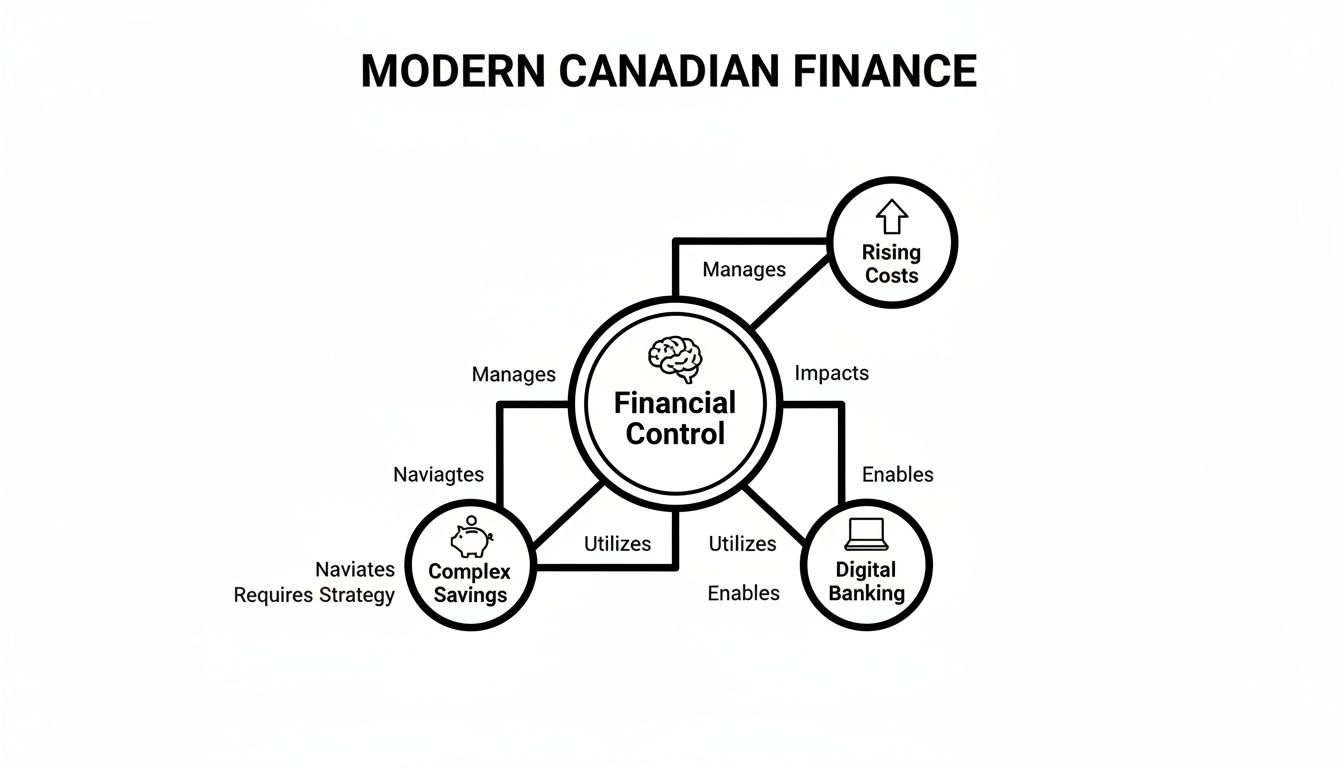
As you can see, getting a real grip on your money means juggling digital banking, complex savings, and rising costs all at once.
Does It Handle Canadian Registered Accounts?
Beyond simple chequing and savings, the best personal finance software for Canada knows how to handle our registered accounts. This means tools that can properly track your Tax-Free Savings Account (TFSA) and Registered Retirement Savings Plan (RRSP) contribution room.
Think about it: trying to max out your TFSA without going over the limit can be tricky. A good app won't just show your investment balance; it will help you avoid costly over-contribution penalties. For families, tracking Registered Education Savings Plans (RESPs) to maximize government grants is a huge benefit. A generic, US-based app is completely blind to this.
What About Other Canadian Financial Quirks?
Life in Canada brings other financial details that your software needs to manage. If you shop on U.S. websites or travel, multi-currency support is a must. Your app should cleanly convert transactions in USD back to Canadian dollars without guesswork.
For freelancers and small business owners, tracking Goods and Services Tax (GST) or Harmonized Sales Tax (HST) is non-negotiable. A tool that lets you tag and sort these expenses makes tax time infinitely less painful. Imagine a graphic designer in Halifax being able to tag every software subscription as a business expense with one click.
The right software doesn’t just show you where your money went; it helps you see where it’s going. It provides a single, clear picture of your entire Canadian financial life.
This is exactly where a platform like NeoSpend shines. It was built with these Canadian realities in mind. NeoSpend provides secure connections to a massive list of Canadian banks and credit unions, giving you that unified dashboard you need. Its smart tracking is also built to recognize TFSAs and RRSPs, helping a family create a specific goal for their RESP and watch their progress. It takes a complicated task and makes it simple.
Must-Have Features in Canadian Personal Finance Software
When comparing apps, it's easy to get distracted by flashy charts. This table breaks down the core features essential for managing your money in Canada.
| Feature Category | What to Look For | Why It's Critical for Canadians |
|---|---|---|
| Bank Connectivity | Direct, secure links to major Canadian banks (RBC, TD, BMO, etc.) and credit unions (Vancity, Desjardins). | Without this, you're stuck with manual data entry, which is inefficient and error-prone. |
| Registered Accounts | Specific tracking for TFSA and RRSP contribution limits. Support for RESPs is a major plus for families. | Prevents costly over-contribution penalties and helps you maximize tax-sheltered growth and government grants. |
| Multi-Currency | Automatic conversion of transactions in USD and other currencies to CAD. | Essential for online shopping, travel, or cross-border income to get an accurate financial picture. |
| Tax Support | Ability to categorize and tag expenses for GST/HST and other business-related deductions. | Dramatically simplifies tax preparation for freelancers, gig workers, and small business owners. |
| Investment Tracking | Integration with Canadian brokerages like Wealthsimple or Questrade to monitor investment performance. | Provides a complete net worth view by combining your banking, savings, and investment data in one place. |
| Budgeting & Goals | Flexible budgeting categories and goal-setting features that reflect Canadian spending habits. | Helps you plan for uniquely Canadian goals, like saving for a down payment or funding an RESP. |
Ultimately, a tool that ticks these boxes isn't just a nice-to-have; it's a fundamental part of building a solid financial foundation in Canada.
How to Choose the Right Financial Tool for Your Life Stage
Your financial needs change over time. The app that was perfect for managing your student loan probably won't cut it when you’re juggling a mortgage and RESPs. The trick to picking the right personal finance software in Canada is finding something that grows with you.
Think about it. A student in Montreal trying to manage their loans has a different financial picture than a freelancer in Calgary tracking invoices. You need a platform that’s powerful enough for your future goals but simple enough for your life right now.
Finding an adaptable tool saves you the headache of migrating years of financial history every time your life takes a new turn.
Matching Software Features to Your Financial Goals
Let's get specific. A young professional just starting their career is likely focused on paying off debt and starting to invest. For them, a tool that visualizes net worth growth is a huge motivator.
Imagine someone in their late 20s in Toronto saving for their first condo. They need a tool that lets them set a clear down payment goal, track TFSA contributions, and see a projection of when they’ll hit their target.
Now, contrast that with a family in Calgary. Their financial world has shifted. They might need:
- Shared Budgets: A way for both partners to manage household spending in one place.
- RESP Goal Tracking: A feature to monitor contributions and maximize government grants.
- Subscription Management: A quick way to spot duplicate streaming services draining their account.
This is where a flexible platform like NeoSpend makes a difference. Its dashboards and goals are customizable. You can set it up to aggressively track a student loan payoff just as easily as you can configure it to save for a family vacation. It’s designed to adapt to your priorities.
From Side Hustle to Small Business in Canada
The rise of freelancing has blurred the line between personal and business finances for many Canadians. This isn't a small trend; North America contributes 38% to the global personal finance software market's growth, and Canadian small businesses are projected to grow significantly. A good tool helps you draw a clear line between personal and business expenses. You can see more on this in a recent industry analysis.
The best personal finance software for Canadians doesn't just manage your money today—it provides the framework to support your ambitions for tomorrow.
For freelancers, this means easily tagging business expenses for tax season. NeoSpend nails this with simple, customizable tags. You can sort a business lunch from a personal dinner with a single click, making tax time a breeze.
In the end, making the right choice is about foresight. Ask yourself where you want to be in five years. Pick a tool that already has the features you’ll need when you get there.
How to Set Up Your Personal Finance Software for Success
Getting started with a new money management app can feel like a chore, but that first hour is where the magic happens. Let's walk through how to get it done right so you see the payoff immediately.

First, connect your accounts. A solid platform like NeoSpend will use bank-level, 256-bit encryption and a read-only connection. This is key—it means the software can see your transactions to help you, but it has zero ability to actually move your money. Start by linking your main chequing account and the credit card you use most often.
Bringing Your Financial Story Together in One Place
Once connected, the software will pull in your transaction history. This history is gold because it’s what will help you build a realistic budget from day one.
While it’s working, customize your spending categories. The defaults are usually too generic. Get specific with categories that reflect your Canadian life:
- Groceries (Loblaws)
- Groceries (Farmers Market)
- Coffee (Tim Hortons)
- Takeout & Restaurants
- Kids' Activities
This detail turns a simple expense tracker into a powerful financial tool. Inside NeoSpend, you can create custom tags and set up rules to automate this. For example, a rule can automatically tag every "GoodLife Fitness" charge as "Health & Wellness," saving you manual work later.
The goal of this first hour isn't to scrutinize every penny. It’s to build a system that does the heavy lifting for you, freeing you up to make smarter decisions.
With your daily accounts linked, bring in the rest of your financial picture. Connect your savings accounts, mortgage, car loan, and investment accounts like your TFSA or RRSP. Seeing your entire net worth in one place is often the "aha!" moment where the value of using personal finance software for Canada really clicks.
Setting Your First Budgets and Smart Alerts
Now for the fun part: setting up a simple budget. Don’t aim for perfection. Just look at what you actually spent last month on groceries or takeout, and set your initial budget slightly below that. For instance, if you see you spent $350 on restaurants, try setting this month's budget to $300. It’s a realistic, achievable goal.
Finally, set up smart alerts to act as your financial guardrails. These are game-changers. Configure notifications for things like:
- Upcoming Bills: Get a nudge before your Rogers or hydro payment is due.
- Budget Limits: Get a ping when you're at 80% of your "Entertainment" budget.
- Large Purchases: Get an instant heads-up for any transaction over $200.
These alerts help you stay ahead, preventing late fees and accidental overspending. In just one hour, you’ve gone from scattered accounts to a connected system that gives you real, actionable insights.
Your First 30 Days: From Tracking to Thriving
Great software is just a tool. The real magic happens when you use it to build better money habits. Your first month is the perfect chance to hit reset on how you handle your money.

The first week is all about observation. Don't change a thing. Your only job is to let the software track every transaction to give you an unfiltered look at where your cash is actually going. You might be shocked at what those daily coffees really add up to.
How to Turn Financial Data Into Action
Once week two rolls around, use that data to build a budget that fits your life. If you spent $150 on going out, aiming for $125 next month is a smart, achievable step. This is where a tool like NeoSpend proves its worth. Its dashboards give you a clear visual of your spending patterns, so you're making decisions based on facts, not guesswork.
Week three is when you start building momentum by setting meaningful goals. Get specific:
- Put $1,000 into an emergency fund over the next three months.
- Throw an extra $200 at your credit card debt this month.
- Boost your TFSA contribution by an extra $50.
Watching these small wins stack up is incredibly motivating. It turns budgeting from a chore into a challenge you can win.
Making Your New Money Habits Stick
Finally, week four is for review. Pull up the monthly report and see how you did. Where did you nail your budget? Where did you slip up? There’s no judgment—just valuable data to help you make smarter moves next month.
The goal isn't perfection. It’s progress. Each month, you'll get a little smarter and feel a little more in control, turning tiny adjustments into massive long-term financial health.
This simple cycle is powerful. Users of personal finance software in Canada often boost their savings by 5-10% in the first few months. With adoption rates jumping 15-20% each year, it's clear more Canadians are catching on. You can dive into the numbers by reading the full market research. This approach breaks down an overwhelming task into small, achievable steps.
Your Top Questions About Canadian Personal Finance Software
When you’re thinking about connecting your financial life to an app, a few questions always come up. Let's tackle the most common ones.
The number one concern is security. Is it actually safe to link my bank accounts? Reputable platforms like NeoSpend use bank-level, 256-bit encryption to create a read-only connection. This means the software gets a secure peek at your transaction data to help you budget, but it can't touch your money. It has zero ability to make payments, move funds, or see your login details. It's like giving someone a statement to look at, not your debit card and PIN.
Will It Work With My Canadian Bank or Credit Union?
This question comes up a lot. It’s easy to connect to the big banks like RBC or TD, but what about your local credit union in Saskatchewan? The best platforms are constantly adding to their list of supported institutions. Before you sign up, do a quick search on their site to see if your specific bank or brokerage is on the list. This is the only way to guarantee you get a complete view of your money.
A huge concern we hear is about privacy. Canadians are rightly protective of their data. It’s critical to choose a service with a rock-solid privacy policy that clearly states they will never sell or share your personal financial information.
Finally, how do these apps handle our uniquely Canadian accounts like TFSAs or RRSPs? A tool built for Canadians should have dedicated features for this. It needs to help you monitor your contribution room and see how these accounts fit into your overall net worth.
These aren't minor details—they're essential. The right personal finance software for Canada tackles these concerns head-on with transparent security, extensive bank connections, and features designed for the way we actually manage our money.
Takeaway: Choosing the right personal finance software made for Canadians can transform your financial life from chaotic to controlled. By connecting all your accounts, tracking uniquely Canadian goals like RRSP and TFSA contributions, and turning data into actionable habits, you can build a smarter financial future.
Ready to see your entire financial picture in one secure place? Discover how NeoSpend can give you the clarity and control to reach your goals. Try NeoSpend today and get a smarter view of your money.