
Every year, you have to take a certain amount of cash out of your Registered Retirement Income Fund (RRIF). This is your minimum RRIF withdrawal, and it's not optional—it's the smallest amount the government legally requires you to withdraw, starting the year after you open the account.
Think of it as the government's way of ensuring you start spending (and paying tax on) the retirement nest egg you spent years building up tax-free. This guide will walk you through everything a Canadian retiree needs to know.
What Is a RRIF and Why Are There Withdrawal Rules?
A Registered Retirement Income Fund (RRIF) is what your Registered Retirement Savings Plan (RRSP) typically becomes in retirement. By the end of the year you turn 71, you must close your RRSP and convert it into an income option. For most Canadians, that means a RRIF.
This is where your savings shift gears from growth to income. The primary purpose of a RRIF is to provide you with a steady stream of cash throughout your retirement years.
The government mandates a minimum RRIF withdrawal for one key reason: taxes. For all the years you contributed to your RRSP, you received a tax deduction, and your investments grew tax-deferred. Now, it's time for the Canada Revenue Agency (CRA) to collect its share. The minimum withdrawal schedule forces you to gradually pull money out, which then counts as taxable income for that year.
This system has a few major effects on your retirement plan:
- It creates a predictable income floor. You know you’ll have at least this much cash coming in from your RRIF each year.
- It impacts your tax planning. Every dollar you withdraw is added to your income, which could push you into a higher tax bracket or affect government benefits like Old Age Security (OAS).
- It requires your attention. You must take the money out by December 31st each year. Missing this deadline comes with steep penalties.
Why the Minimum Withdrawal Matters for Your Budget
Understanding your minimum withdrawal is the first step to mastering your retirement income. It’s not just an administrative task; it’s a fundamental part of your annual budget.
Let’s imagine a practical Canadian scenario. Say you’re 72 and your RRIF was worth $500,000 on January 1st. The government’s formula requires you to withdraw at least 5.40% of that value. That works out to $27,000 for the year. This money becomes part of your income, helping cover everything from groceries in Vancouver to a winter trip to escape the snow in Edmonton.
An important detail: your financial institution typically won't withhold tax on the minimum amount. You get the full $27,000, but you're responsible for setting aside what you'll owe. You can learn more about how RRIF withholding tax works from the CRA.
This is where a smart money management tool like NeoSpend makes a huge difference. By connecting all your accounts, you get a clear, complete view of your money. You can see when your RRIF withdrawal lands, track how it impacts your cash flow, and build a budget that makes sense for your retirement lifestyle. NeoSpend helps you turn a complex financial task into a simple, manageable part of your strategy.
How to Calculate Your Minimum RRIF Withdrawal
Knowing the rules behind your RRIF withdrawal is a great start, but learning to calculate the exact dollar amount is where you take real control of your retirement income. The good news is the formula is straightforward and applies to every Canadian with a RRIF.
The calculation is based on just two numbers: your RRIF's value on January 1st and a percentage factor set by the federal government based on your age.
The formula is as simple as it gets:
(Your RRIF's Market Value on January 1st) x (The Government's Percentage Factor) = Your Minimum Annual Withdrawal
This means the amount you must withdraw will change each year, influenced by your age and your portfolio's performance in the previous year.
The Two Parts of the RRIF Formula Explained
Let's break down each piece of the equation so you know exactly what they mean.
- Your RRIF's Market Value on January 1st: Think of this as a snapshot in time. It's the total value of all investments in your RRIF at the start of the calendar year. It doesn’t matter if the market goes up or down on January 2nd—the calculation for the year is already locked in.
- The Government's Percentage Factor: This is a pre-set rate that increases as you get older. The government publishes a table with a specific percentage for every age, designed to gradually draw down your RRIF funds over your lifetime.
This infographic clearly shows how a starting balance becomes a minimum withdrawal and, ultimately, taxable income.
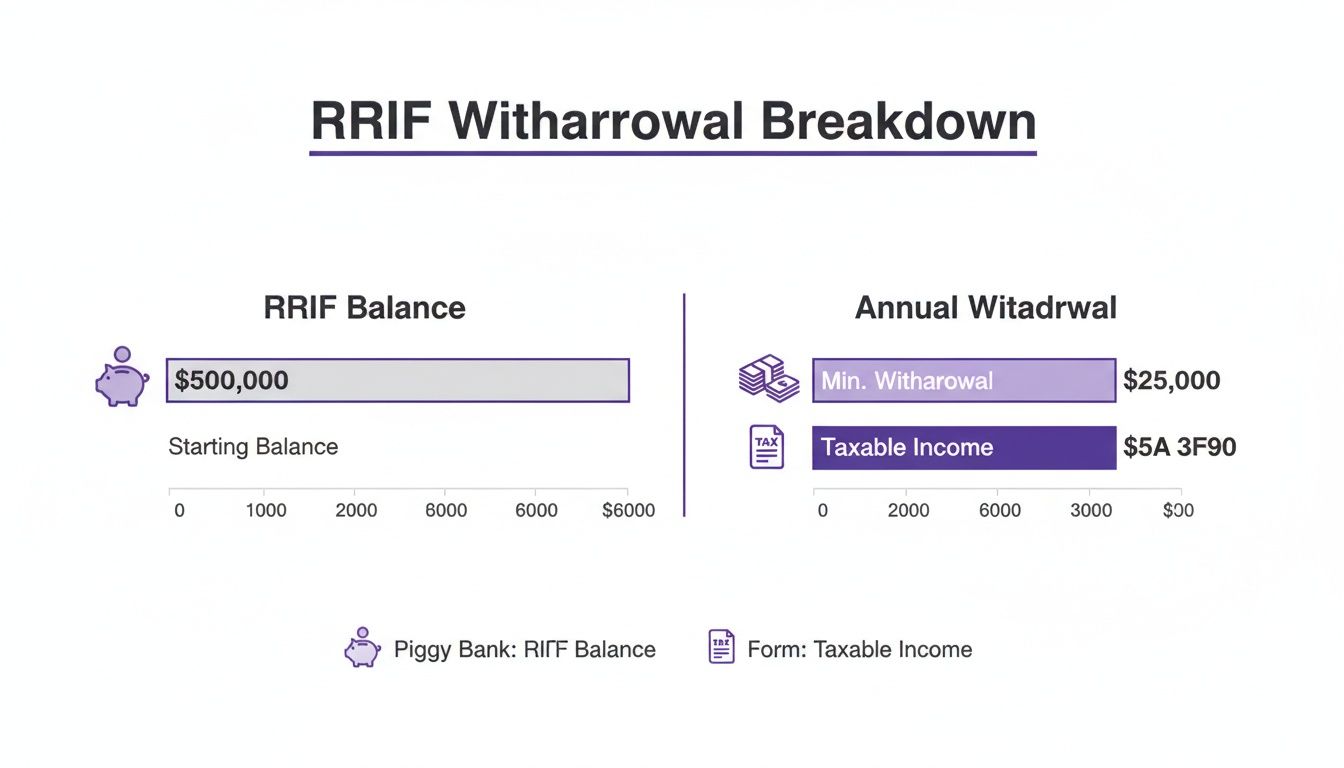
As you can see, a healthy RRIF balance generates a required withdrawal, which then becomes part of your annual taxable income.
Finding Your Official Percentage Factor
Before you can do the math, you need the right percentage factor for your age. The government provides a clear schedule that your financial institution uses to determine your minimum payment.
For example, the year you turn 71 is a key milestone. This is when you must convert your RRSP to a RRIF, and the minimum withdrawal rate starts at 5.28% of your account's value on January 1st.
To give you a better idea of how this progresses, here are the official government rates for key ages.
RRIF Minimum Annual Withdrawal Percentages by Age
This table shows the prescribed percentage factor you must withdraw from your RRIF based on your age at the beginning of the year.
| Age (as of Jan 1) | Minimum Withdrawal Percentage |
|---|---|
| 71 | 5.28% |
| 75 | 5.82% |
| 80 | 6.82% |
| 85 | 8.51% |
| 90 | 11.92% |
| 95+ | 20.00% |
As you can see, the percentage climbs steadily as you age. This is designed to gradually draw down the funds over your lifetime. For a complete list, you can always check the full schedule on the Government of Canada's website.
Putting It All Together With Real Canadian Examples
Let’s run the numbers with a couple of everyday scenarios to see how this works in the real world.
Example 1: A Retiree in Halifax
- Meet Jean-Pierre: He is 71 years old and lives in Halifax.
- His RRIF Value: On January 1st, his RRIF was worth $350,000.
- His Percentage Factor: At age 71, his required withdrawal rate is 5.28%.
- The Calculation: $350,000 x 0.0528 = $18,480
This means Jean-Pierre must withdraw at least $18,480 from his RRIF before December 31st. He could take it all at once or break it into monthly payments of $1,540 to cover his regular expenses.
Example 2: A Retiree in Calgary
- Meet Susan: She is 75 years old and lives in Calgary.
- Her RRIF Value: On January 1st, her RRIF was worth $600,000.
- Her Percentage Factor: At age 75, her factor is 5.82%.
- The Calculation: $600,000 x 0.0582 = $34,920
Susan’s minimum withdrawal for the year is $34,920. This amount will be added to her other income sources, like her pension and Old Age Security, to determine her total taxable income.
Once you understand this simple math, you can easily verify the figures from your financial institution and plan your annual budget with confidence. Keeping track of this income and how it lines up with your spending is easy with a tool like NeoSpend, which provides a clear, complete view of your financial picture.
Navigating Tax Rules on RRIF Withdrawals
Calculating your minimum RRIF withdrawal is just the first step. The real challenge—and where good planning pays off—is managing the associated taxes. Let's be clear: every dollar you withdraw from your RRIF is fully taxable income.
Your money enjoyed tax-deferred growth for years inside an RRSP. Now that it’s time to use it, the Canada Revenue Agency (CRA) treats those withdrawals just like a paycheque or pension income. This can have a major impact on your annual tax bill and even your eligibility for government benefits.

Understanding Withholding Tax on RRIF Payments
Here’s a crucial detail: there’s a big difference between taking your minimum payment and taking anything extra.
When you withdraw only the minimum amount, your financial institution is not required to hold back any tax at the source. You get the full amount, but you are responsible for paying the tax when you file your return.
The rules change the moment you withdraw even one dollar more than your minimum. That’s when withholding tax kicks in. Your financial institution will immediately deduct a percentage of that excess amount and send it directly to the CRA on your behalf. Understanding this is critical for managing your retirement cash flow.
Federal Withholding Tax Rates
The federal government has a tiered system for withholding tax on any RRIF withdrawals above your annual minimum. The rate depends on how much extra you take out. These rules apply across Canada, except in Quebec, which has its own system.
Here's a quick look at the rates your financial institution will apply to amounts withdrawn above the minimum.
Federal Withholding Tax Rates on RRIF Withdrawals (Excluding Quebec)
Tax withheld at source only applies to amounts withdrawn above the annual minimum.
| Withdrawal Amount Above Minimum | Withholding Tax Rate |
|---|---|
| Up to $5,000 | 10% |
| Between $5,001 and $15,000 | 20% |
| Over $15,000 | 30% |
Let's make this practical. Say your minimum withdrawal is $20,000, but you need an extra $6,000 for a new roof. That extra $6,000 falls into the 20% bracket. Your institution would withhold $1,200 ($6,000 x 20%) and send it to the CRA, so you’d receive $4,800 of that extra amount.
Remember, these are just prepayments on your total tax bill.
Special Tax Rules for Quebec Residents
If you live in Quebec, you play by a different set of rules. The withholding tax structure is a combination of federal and provincial deductions. Unlike the rest of Canada, even minimum withdrawals can have tax withheld. Any withdrawals above the minimum trigger a combined federal rate of 5-15% plus a flat 14% provincial tax from Revenu Québec, which can add up to 29% on larger withdrawals. For a deeper dive, you can find more insights about Quebec's unique RRIF tax rules from Sun Life.
Key Takeaway: Withholding tax is just an instalment payment toward your final tax bill. Depending on your total income, it might not be enough to cover everything you owe.
Practical Tips for Managing Your RRIF Tax Bill
A surprise tax bill is the last thing any retiree needs. A little proactive planning can make all the difference.
Here are a few simple strategies to keep your RRIF taxes under control:
- Create a Tax Savings Account: If you only take the minimum, estimate your marginal tax rate. Every time you receive a RRIF payment, transfer that percentage into a separate high-interest savings account. Come tax time, the money is ready and waiting.
- Request Extra Withholding: You can always ask your financial institution to deduct extra tax from your payments—even on your minimum amount. This is a simple way to pre-pay your tax bill and avoid a large payment in April.
- Use a Smart Money App: Tools like NeoSpend are a huge help. You can see your RRIF income as it arrives and set up automatic transfers to your "tax savings" stash. It removes the guesswork and ensures you’re always prepared.
Smart Strategies for Your RRIF Withdrawal Plan
Once you've mastered the basics, you can start making your minimum RRIF withdrawal work smarter for you. The government sets the minimum, but you control the strategy. A bit of forward-thinking can help preserve your capital, reduce your tax bill, and ensure your income stream fits your lifestyle.
It's about shifting from simply meeting a requirement to actively optimizing your retirement funds for the long term.
Use a Younger Spouse's Age to Your Advantage
One of the simplest yet most effective RRIF strategies is the spousal age election. When you set up your RRIF, you can choose to calculate the minimum withdrawal based on your age or your younger spouse's age. If your spouse or common-law partner is younger, this is a powerful option.
Choosing their younger age lowers the percentage factor used in the calculation. This simple decision reduces the amount you’re forced to withdraw each year, leaving more of your capital inside the RRIF to continue growing tax-deferred.
Example: A Spousal RRIF in Action
- Meet David: He's 75 years old with a $400,000 RRIF. His minimum withdrawal factor is 5.82%.
- His Wife, Maria: She's 70 years old, so her age factor is only 5.00%.
- The Difference:
- Based on David's age: $400,000 x 5.82% = $23,280
- Based on Maria's age: $400,000 x 5.00% = $20,000
By using Maria’s younger age, David keeps an extra $3,280 invested and growing in his RRIF for the year. Over many years, that compounding effect can significantly preserve his nest egg.
Master the Timing of Your Withdrawals
Your minimum withdrawal is an annual requirement, but you don't have to take it all at once. You have complete flexibility in how you receive the payments. Financial institutions allow you to set up a schedule that aligns with your cash flow needs.
- Monthly Payments: Creates a predictable, paycheque-like income stream to cover regular bills.
- Quarterly Payments: A great option for tackling larger, seasonal costs like property taxes.
- Annual Payment: A lump sum that offers flexibility for irregular spending patterns.
The goal is to match your withdrawal schedule to your budget. This is where an app like NeoSpend can be a game-changer. By tracking your recurring bills and subscriptions, NeoSpend gives you a clear picture of your monthly cash needs. You can then set up your RRIF payments to align perfectly, ensuring money arrives right when you need it.
Remember this: The first minimum withdrawal must be taken by the end of the calendar year after the year you open your RRIF. You get a full year of tax-deferred growth before the withdrawals must begin.
Consider In-Kind Withdrawals to Stay Invested
What if you need to make your withdrawal when the market is down? Selling investments at a loss can be painful. The good news is, you don’t always have to. An "in-kind" withdrawal is a clever solution.
This strategy allows you to transfer investments—like stocks or mutual funds—directly from your RRIF to a non-registered account (like a cash or margin account) without selling them. The market value of those assets on the transfer date counts toward your minimum withdrawal.
You’ll still pay income tax on that value, just as if you took cash. But the significant benefit is that your investments remain in the market, positioned to recover and grow when conditions improve. It's an excellent way to avoid locking in losses by selling at an inopportune time.
Putting Your RRIF on Autopilot with NeoSpend
Knowing the rules for your minimum RRIF withdrawal is the first step. But managing that income so it works seamlessly with the rest of your financial life is what creates a comfortable retirement. This is where a modern tool can make all the difference, moving you from simply tracking numbers to feeling truly in control.

Think of NeoSpend as your financial command centre. Instead of juggling different banking apps and statements, you can connect everything—your RRIF, chequing account, savings, and TFSA—in one place. This unified view is a game-changer for seeing how your RRIF income fits into your daily life.
Match Your RRIF Cash Flow to Your Real-Life Bills
One of the trickiest parts of retirement budgeting is when income and expenses are out of sync. Your RRIF withdrawal might land monthly, but your bills—from hydro and property taxes to your streaming services—have their own due dates.
This is where NeoSpend excels. Its bill and subscription tracking automatically identifies your recurring payments and deadlines. Suddenly, you can:
- See your entire month at a glance: Know exactly what's due and when, allowing you to time your RRIF withdrawals to align with your expenses.
- Avoid late fees: Get friendly reminders before bills are due so the money is always ready.
- Find and cancel "phantom" subscriptions: Spot those services you signed up for years ago and forgot about, freeing up extra cash every month.
When your RRIF income is perfectly aligned with your spending, your finances feel smoother and more predictable. It’s a proactive way to ensure every dollar you withdraw is working for you.
NeoSpend transforms your RRIF withdrawal from just another transaction into an integrated part of your retirement budget. It’s about making your money work for you, not the other way around.
Plan Ahead with Insights from Neo AI
A healthy financial life isn't just about the past; it's about what’s coming next. NeoSpend’s smart assistant, Neo AI, helps you look forward. It shows you how your RRIF income will impact your budget over time, helping you spot a potential cash crunch or a surprise surplus before it happens.
This foresight is incredibly powerful. For example, if you're considering a big purchase that requires an extra RRIF withdrawal, Neo AI can model how it will affect your cash flow in the coming months. You can make decisions based on data, not guesswork.
With bank-level security and a commitment to protecting your privacy, NeoSpend helps you feel organized, in control, and confident about your money throughout your retirement.
Your Top RRIF Withdrawal Questions, Answered
Once you understand the basics, a few common "what-if" questions often arise around your minimum RRIF withdrawal. Here are clear, practical answers to some of the most frequent questions Canadians have, so you can manage your retirement income confidently.
What Happens If I Forget to Take My Minimum RRIF Withdrawal?
Missing the December 31st deadline is a costly mistake. If you fail to withdraw the minimum amount, the Canada Revenue Agency (CRA) still considers that money as income for the year. The entire minimum amount is added to your taxable income, meaning you'll pay tax on money you never actually received. It's a painful and avoidable situation.
While your financial institution is supposed to ensure the payment is made, the ultimate responsibility is yours. It's wise to check in with them in the fall to confirm everything is on track.
A simple system can prevent this. Use an app like NeoSpend to set a recurring reminder in your calendar for early December. A little planning goes a long way.
Can I Withdraw More Than the Minimum Amount from My RRIF?
Yes, absolutely. The "minimum" is just a floor, not a ceiling. There is no maximum limit on how much you can withdraw from your RRIF in a given year. This flexibility is great for handling major expenses, like a home renovation, helping family, or taking a dream vacation.
However, you must consider the tax implications. Any amount you withdraw above the minimum is subject to withholding tax at the source. Your bank will deduct a percentage for the CRA before the money reaches your account.
Furthermore, the entire withdrawal (both the minimum and the extra) is added to your taxable income. A large withdrawal could easily push you into a higher tax bracket and might even trigger a clawback of your Old Age Security (OAS) benefits. Plan these larger withdrawals carefully.
How Do Market Ups and Downs Affect My RRIF Withdrawal?
The stock market's performance has a significant, though slightly delayed, effect on your RRIF. Your minimum withdrawal is always calculated based on your RRIF's value on one specific day: January 1st of that year.
This creates a time lag:
- After a strong market year: Your January 1st balance will be higher, meaning your required withdrawal for the year will also be larger.
- After a weak market year: Your January 1st balance will be lower, so your required withdrawal will be smaller.
This can be challenging in a down market, as the rules may force you to sell investments when prices are low just to meet your withdrawal requirement, effectively locking in losses. This is where strategies like an "in-kind" withdrawal can be a portfolio-saver.
A Little History Lesson: The government occasionally provides relief during major economic downturns. In 2020, for example, they allowed retirees to reduce their minimum RRIF withdrawal by 25% to avoid selling assets at depressed prices. However, these are rare exceptions and should not be relied upon for regular planning.
Can I Stop or Pause My Minimum RRIF Withdrawals?
No, you cannot. Once your RRIF is established, the minimum RRIF withdrawals are mandatory every year. The system is designed to ensure that tax-sheltered funds are gradually paid out—and taxed—over your lifetime.
This obligation continues annually until the account is depleted. As noted, the only exceptions have been during major economic crises, such as the 2008 financial crisis and the 2020 pandemic, when temporary 25% reductions were permitted.
For your personal financial planning, you should always assume the full minimum withdrawal is required every year without interruption.
Key Takeaway: Managing your retirement income is about having a clear plan and the right tools. By understanding the rules for your minimum RRIF withdrawal and using smart strategies, you can make your retirement savings work for you. NeoSpend helps you see the whole picture, connecting your RRIF income to your real-life spending for a more organized and stress-free retirement. See how you can manage your money smarter by visiting https://neospend.com.