Feeling the squeeze as payday approaches is an all-too-common stress for many Canadians. If you're ready to stop living paycheck to paycheck, you need a simple, practical plan. It all comes down to four key moves: figure out where your money is actually going, build a bare-bones budget for just the essentials, scrape together a small emergency fund, and start hitting your most expensive debt. Getting a handle on these four things is what creates the breathing room you need to finally feel in control.
What It Really Means to Live Paycheck to Paycheck in Canada
That feeling of dread as payday approaches? It's the constant pressure of your paycheque landing just in time to cover rent, bills, and groceries, with absolutely nothing left over for savings, let alone emergencies or future plans.
This isn’t just a problem for people with low incomes. It hits everyone, from a new grad in Toronto barely covering rent to a family in Halifax watching their grocery bill creep up every single week.
Living paycheck to paycheck traps you in a survival loop. You're always one flat tire or unexpected dental bill away from falling into debt. That kind of stress is exhausting. But breaking free is possible, and it starts with realizing you have the power to change things.
The Four Pillars of Financial Control
Gaining control isn't about trying to fix everything at once. That's a recipe for burnout. Instead, we’re going to focus on four foundational steps that build on each other and create real momentum.
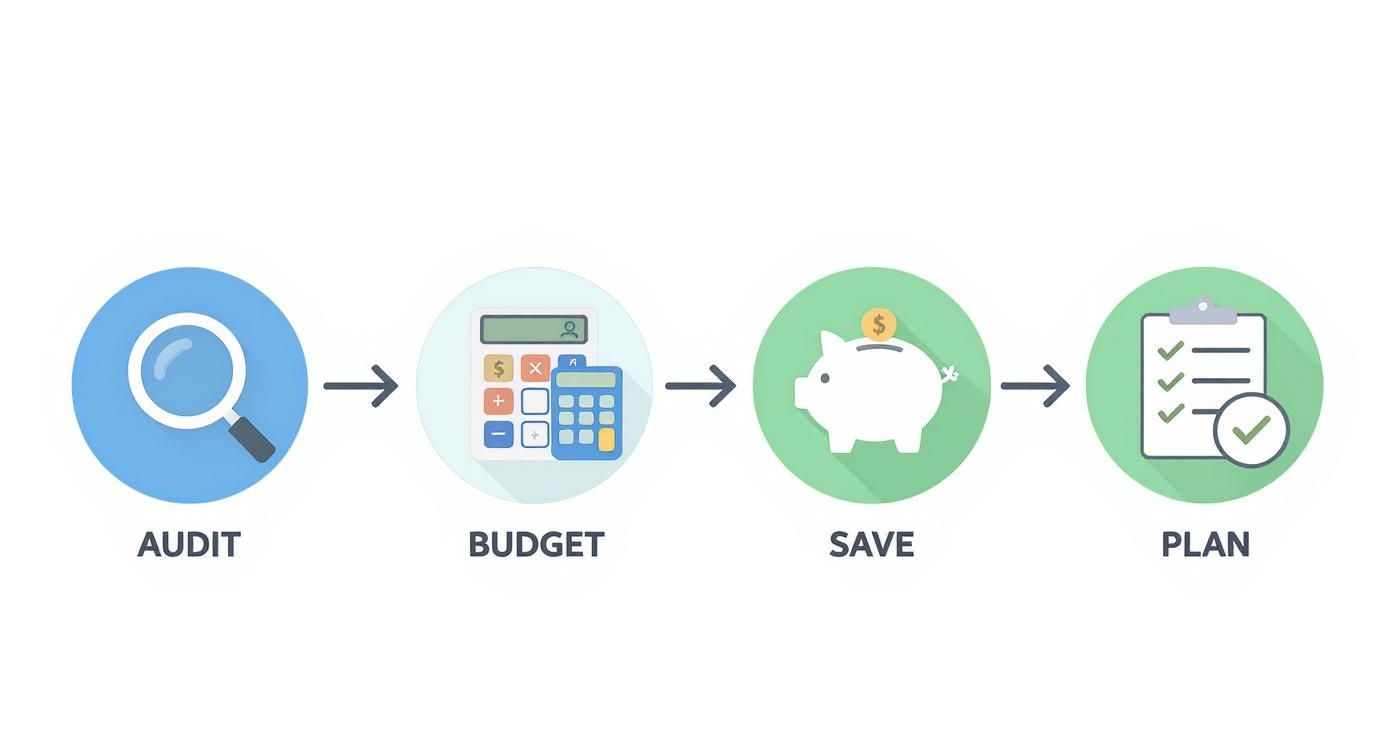
This process isn't complicated. It’s a straightforward path from figuring out what's happening (the Audit) to actively deciding where your money goes (the Plan).
Let's be real—this is a widespread issue, and a lot of it comes from wages simply not keeping up with Canada's high cost of living. Recent research shows that over a third of households don't earn enough to cover basic needs, even with adults working full-time. That stat really highlights how deep this problem runs for so many families. You can learn more about the structural economic challenges many households face.
To get you started, here's a quick look at the first four actions that will give you some desperately needed financial breathing room.
Your First Four Steps to Financial Breathing Room
| Action Step | Why It's Critical | First Small Move |
|---|---|---|
| Money Audit | You can't fix what you can't see. This gives you a brutally honest snapshot of your spending. | Link your bank accounts to an app like NeoSpend to automatically categorize the last 30 days of transactions. |
| Bare-Bones Budget | This isn't about cutting lattes; it's about covering your "four walls"—food, shelter, utilities, transport. | List your essential, non-negotiable monthly bills and their total cost. That's your survival number. |
| Starter Emergency Fund | A small cash buffer is your shield against minor emergencies that would otherwise send you into debt. | Set up an automatic transfer of $25 a week into a separate high-interest savings account. |
| Attack High-Interest Debt | Credit card debt is an emergency. The high interest is actively working against you every single day. | Pick your credit card with the highest interest rate and commit to paying just $20 more than the minimum this month. |
These steps lay the groundwork for everything else. They aren't glamorous, but they are incredibly effective.
Your Path Forward
Throughout this guide, we'll walk through each of these pillars in detail, with practical tips specifically for Canadians. You’ll learn how to do an honest money audit without judging yourself and create a simple budget you can actually stick to. We’ll show you exactly how to build that crucial starter emergency fund and make a smart plan to attack that high-interest debt.
Financial freedom is less about how much you earn and more about how intentionally you manage what you have. It starts with small, consistent actions that build a strong foundation for the future.
This is where modern tools can make a huge difference. An app like NeoSpend is built to do the heavy lifting for you, showing you exactly where your money goes so you can make smarter decisions without spending hours on spreadsheets. By taking these first few steps, you're not just moving numbers around—you're building a more secure, less stressful future for yourself.
Step 1: Conduct an Honest Money Audit
Before you can map out where you’re going, you have to get brutally honest about where you are right now. That means taking a clear, judgment-free look at your spending habits.
A “money audit” sounds intense, but it’s really just tracking every dollar that leaves your account for a month. The goal isn’t to feel bad about that daily coffee or Friday night takeout. It's about gathering cold, hard facts. You can't change what you don't measure, and this is the data that will finally empower you to stop living paycheck-to-paycheck.
Picking Your Tracking Tool
You’ve got a few options here, from old-school to fully automated. The best method is the one you’ll actually stick with for a full 30 days. Consistency is everything.
- Pen and Paper: The classic. Keep a small notebook on you and jot down every single purchase. There’s something powerful about manually writing it down—it forces you to acknowledge every expense in the moment.
- Spreadsheets: If you’re comfortable with digital tools, a simple spreadsheet is a great step up. Make columns for the date, what you bought, a category (like groceries or transport), and the amount. It makes sorting and tallying at the end of the month a breeze.
- Financial Apps: Honestly, this is the easiest way. Apps like NeoSpend securely link to your Canadian bank accounts and credit cards to automatically pull in and categorize every transaction. It completely cuts out the manual work.
Using a tool like NeoSpend takes the most tedious part of the audit off your plate. It does the heavy lifting, serving up your spending habits in simple charts so you can focus on finding insights, not wrestling with data entry.
What to Look For When You’ve Got the Data
Okay, you’ve survived the month. Now it’s time to pour a coffee and look at the numbers. Remember, you’re not here to judge yourself. You're a financial detective looking for clues. Your mission is to see where your money really goes, not where you think it goes.
This audit is your financial starting line. It's not a test you can fail; it's a tool that gives you the clarity to build a real plan. Knowledge is power, and these numbers are your first taste of it.
As you dig in, start by grouping your spending into a few main buckets to see the big picture.
The Three Main Spending Buckets
Almost every expense will fall into one of these three categories. Adding them up will quickly show you where the bulk of your money is going.
- Fixed Costs: These are the predictable, non-negotiable bills that are the same every month. Think rent or mortgage, car insurance, and your cell phone plan. They’re usually the easiest to spot.
- Variable Costs: These are the necessities that change from month to month. This is your groceries, gas for the car, and hydro bill. This bucket is often where you can start finding room to cut back.
- Discretionary Spending (The 'Wants'): This is literally everything else. Dining out, entertainment, streaming subscriptions, hobbies, that random online purchase. This bucket is usually where the biggest surprises are hiding.
Uncovering Your "Spending Leaks"
Now for the fun part. With everything categorized, you can start to pinpoint your “spending leaks.” These are the small, almost unnoticeable expenses that are secretly draining your account over time.
Let's take a young professional in Montreal who always feels broke, despite a decent salary. After running a one-month audit with NeoSpend, she finds this:
- $85 on daily poutine lunches from the place near her office.
- $45 on three different streaming services, one she barely even watches.
- $40 on daily coffees from the café next to the Metro station.
- Total Monthly Leak: A shocking $170
This isn't about telling her she can never have poutine again. It’s about the lightbulb moment of realizing that a few small, unmanaged habits were costing her over $2,000 a year. By packing a lunch three days a week and cutting one subscription, she instantly freed up a significant chunk of cash to kick-start her emergency fund. That’s the real power of an honest money audit.
Alright, you’ve stared your finances in the face and have the honest numbers in front of you. That’s the hardest part, and it’s done. Now it’s time for your first two power moves: creating a temporary “bare-bones” budget and building a starter emergency fund.
These two actions go hand-in-hand. They’re designed to create the breathing room you need to finally get ahead.
Building Your Starter Emergency Fund and Bare-Bones Budget
Think of a bare-bones budget as a short-term financial reset, not a new way of life forever. Its one and only job is to cover your absolute essentials—what many people call your "Four Walls." This is the core spending that keeps everything from falling apart.

What Goes in a Bare-Bones Budget
This budget is simple because it has to be ruthless. It only includes the non-negotiable costs you must cover to live safely and get to work. Everything else gets paused, just for a little while.
- Shelter: Rent or mortgage payments.
- Utilities: Hydro, heat, water, and your most basic internet plan.
- Groceries: Just the food you need for making meals at home. No extras.
- Transportation: Gas for your car or your bus pass—whatever it takes to get to your job.
That's it. Seriously. Anything that doesn't fit into one of these four categories—subscriptions, eating out, new clothes—is off the table for now. The goal isn't to punish yourself; it's to intentionally free up every possible dollar for your next critical mission.
Your First Defence: The $1,000 Starter Emergency Fund
An emergency fund is your financial shield. It's a small cash cushion that stands between you and a total disaster when an unexpected bill lands in your lap. A sudden car repair, a surprise vet bill, or an urgent trip to the dentist—these are the kinds of things that usually force people deeper into high-interest credit card debt.
Your immediate goal is to save $1,000 as fast as you possibly can. This isn't the full three-to-six-month emergency fund you'll build later. This is the starter fund that breaks the cycle of borrowing for every minor crisis.
This small cash buffer is your first real taste of financial security. It’s the difference between a stressful event and a full-blown financial crisis. Knowing you have it changes your entire mindset.
The challenge of living paycheck to paycheck is universal, extending far beyond Canada. Even in places with a strong job market, the rising cost of living keeps people in a tight spot. Data shows that even when the growth of paycheck-to-paycheck households slows, the overall number doesn't really go down because wages just aren't keeping up. You can dig deeper into how economic factors affect household finances to see the bigger picture.
How to Find $1,000 Fast
Finding an extra grand might sound impossible when you're already stretched thin, but when you combine your bare-bones budget with a few creative hustles, you can get there faster than you think. This is all about short-term, focused action.
Quick Wins to Fund Your Starter Emergency Fund:
- Sell Unused Items: Go through your place and find anything you no longer need. Electronics, furniture, old sports equipment, and clothes can sell surprisingly fast on Canadian marketplaces like Kijiji or Facebook Marketplace.
- Have a 'No-Spend' Weekend: Challenge yourself to spend absolutely nothing on non-essentials for a full weekend. Cook with what you already have, find free community events, and move the money you would have spent directly into your savings.
- Pause Subscriptions Immediately: Log into your bank account and start cancelling. Go after all non-essential subscriptions for a few months—streaming services, gym memberships you aren’t using, and random app subscriptions.
- Pick Up Extra Hours: Ask your boss if there are any opportunities for overtime or extra shifts. Even a few extra hours a week can make a huge difference over a month.
- Redirect Your 'Leaks': Remember that money audit? If you were spending $5 a day on coffee, that’s an easy $100 a month right there. Redirect that cash straight into your emergency fund instead.
This whole process is a lot less painful with a tool like NeoSpend. You can set a specific savings goal for your $1,000 starter fund and watch your progress in real-time. The app’s automatic categorization will keep showing you where you can trim more fat from your spending, giving you a clear path to hitting that goal.
Once that first $1,000 is sitting in your account, you’ll feel a sense of control that might have seemed out of reach just a few weeks ago.
Step 2: Create a Plan to Attack High-Interest Debt
If there's one thing that keeps Canadians stuck in the paycheck-to-paycheck loop, it's high-interest debt. It’s that nagging credit card balance or the payday loan that seems to swallow your income whole. Breaking free from that cycle means going on the offensive with a smart, aggressive plan.
This isn’t just about tossing money at your bills whenever you can. It’s about strategically dismantling the debt that’s costing you the most and understanding how it works against you. Once you get that, you can start winning.
Why High-Interest Debt Is a Financial Emergency
Take a typical Canadian credit card with a 19.99% interest rate. When you carry a balance, that interest isn’t just a yearly fee—it compounds daily. You’re literally paying interest on top of your interest. It’s a powerful force that makes getting ahead feel impossible.
Payday loans are on another level entirely. They look like a quick fix when you’re in a jam, but their annual percentage rates (APRs) can skyrocket into the triple digits. It’s a debt trap designed to be nearly impossible to escape with minimum payments alone. These debts don't just cost you money; they actively drain your future wealth.
Choosing Your Debt Repayment Strategy
Once you've got your starter emergency fund in place, it’s time to switch to offence. There are two main battle-tested methods for tackling debt. The right one for you really boils down to what gets you fired up: seeing quick wins or knowing you're saving the most money over time.
The Debt Snowball Method: This one is all about momentum. You list your debts from the smallest balance to the largest, ignoring interest rates for now. You’ll make minimum payments on everything, but every spare dollar gets thrown at the smallest debt. Once that’s gone, you roll its payment amount into the next-smallest debt, creating a "snowball" that grows bigger and faster with each debt you eliminate.
The Debt Avalanche Method: This strategy is pure math. You list your debts from the highest interest rate to the lowest. Again, you make minimum payments on everything, but your extra cash is aimed squarely at the debt with the highest interest rate. This approach saves you the most money in interest in the long run, but it might take a bit longer to get that first "I paid it off!" feeling.
A Real-World Canadian Scenario
Let's picture a family in Calgary with two major debts, not counting their mortgage:
- A retail store credit card with a $700 balance at 24.99%.
- A major bank Visa with a $5,000 balance at 19.99%.
With the debt snowball method, they'd attack the $700 retail card first. Knocking it out fast would feel like a huge win and free up that payment to start chipping away at the bigger Visa balance.
With the debt avalanche method, they'd also target the retail card first, but because its 24.99% interest rate is the highest. In this case, both roads lead to the same starting point. But if the Visa had the higher rate, the avalanche method would demand they tackle that beast first, despite the bigger balance.
The best debt repayment plan is the one you’ll actually stick with. Whether you're motivated by small victories (snowball) or by the numbers (avalanche), the most important thing is to choose one and commit.
Pro-Tips for Canadians Attacking Debt
Just picking a strategy is half the battle. You can put your foot on the gas and speed up your progress by being a little proactive.
Call Your Bank: Seriously, just call the number on the back of your credit card and ask for a lower interest rate. If you have a decent history of on-time payments, they might just lower it to keep you as a customer. Every percentage point down means more of your payment hits the principal.
Consider a Consolidation Loan: If you're juggling multiple high-interest debts, a debt consolidation loan from a bank or credit union can be a game-changer. You take out one new loan at a lower interest rate to wipe out all your other debts. You're left with a single, manageable monthly payment, which simplifies your life and can save you a ton of money.
This is where a tool like NeoSpend can become your secret weapon. It gives you a crystal-clear view of exactly how much you're forking over in interest each month across all your accounts. Seeing that number in black and white is sometimes the only motivation you need to stay on track and crush that debt for good.
Step 3: Automate Your Finances to Build Long-Term Wealth
So far, we’ve been playing defence. You’ve put in the hard work to diagnose your cash flow, build a budget, and create an emergency fund—all crucial steps for getting your head above water.
Now, it’s time to go on offence. This is where we shift from simply surviving to actively building a more secure and prosperous future. And the single most powerful tool in your playbook is automation.
The idea is simple but profound: pay yourself first. Before a single dollar from your paycheque goes to bills, groceries, or anything else, a piece of it gets automatically funnelled toward your future self.
This one habit takes willpower completely out of the picture. No more remembering to save. No more fighting the urge to spend that extra cash. The money is just gone—working for you behind the scenes.
Set It and Forget It: The Power of Automatic Transfers
Getting this set up is surprisingly easy. Just log into your online banking and create a recurring transfer from your chequing account to your savings accounts. The key is to time it for the exact day you get paid.
It doesn't need to be a huge amount. Let's be realistic.
Imagine you set up an automatic transfer for just $75 every payday. It’s small enough that you probably won't even notice it's gone from your daily spending. But over a year, that’s $1,950 you've socked away without lifting a finger.
We know the strain of managing expenses is real. Recent data shows that over 60% of low-income households struggled to cover essentials like food and housing, a figure that jumps to 71% for families with kids. This is precisely why building a financial buffer is so critical. Even small, automated savings can be the first step in breaking that cycle. You can learn more about the challenges faced by low-income families.
Choosing the Right Savings Tools in Canada
Once you've got money moving automatically, you need to make sure it's going to the right place. For Canadians, there are two accounts you absolutely need to know about.
The Tax-Free Savings Account (TFSA): Don’t let the name fool you—a TFSA isn't just a basic savings account. It's a powerhouse for investing. Any money you put in grows completely tax-free. When you pull it out, you won't owe a dime to the CRA on your investment gains. Its flexibility makes it perfect for mid-term goals, like saving for a down payment or a new car.
The Registered Retirement Savings Plan (RRSP): This is your long-game wealth-building machine. Contributions to an RRSP are tax-deductible, which means you lower your taxable income for the year and often get a sweet tax refund. Your money then grows tax-deferred until you’re ready to retire.
Automation is the antidote to financial procrastination. By making saving the default option, you ensure your future goals are always being funded, turning long-term wealth into an inevitability, not an accident.
How NeoSpend Simplifies Automation
Okay, so how much should you actually automate? It can feel like you're just pulling a number out of thin air.
This is where a tool like NeoSpend becomes your co-pilot. By automatically tracking where your money goes, the app gives you a crystal-clear picture of your real cash flow.
You can see exactly how much you consistently have left after all the bills and essential spending are handled. This insight takes the fear out of the equation. Instead of guessing, you can confidently set up a transfer for an amount you know you can afford, making sure your journey away from the paycheck-to-paycheck life is built on solid data, not just hope.
Your Top Questions Answered
Deciding to break the paycheck-to-paycheck cycle is a huge step, and it's natural to have a few questions pop up along the way. Here are some of the most common hurdles Canadians run into—and how to clear them.
What if My Income Is Irregular?
Budgeting with an income that bounces around from month to month—common for freelancers or gig workers—can feel like trying to nail Jell-O to a wall. I get it. The trick is to stop focusing on the highs and instead plan for the lows.
Start by figuring out your 'bare-bones' budget—the absolute rock-bottom amount you need to keep a roof over your head and the lights on. That number is now your baseline. In any month you earn more than that, the extra cash becomes your secret weapon.
Here’s how you deploy it:
- First up: Get that starter emergency fund to $1,000. No exceptions.
- Next: Attack any high-interest debt with a vengeance.
- Then: Keep beefing up that emergency fund until you have 3-6 months' worth of essential expenses saved.
For freelancers and gig workers, this is exactly where a tool like NeoSpend shines. It helps you spot the patterns in your income over time, so you can actually prepare for the inevitable quiet spells instead of being blindsided by them.
I Have Tried Budgeting Before and Always Fail
You and pretty much everyone else. If you've tried traditional, track-every-penny budgeting and crashed and burned, you're in good company. Most budgets fail because they’re way too restrictive and just plain exhausting to keep up with.
So, let's try something that actually works. Forget the spreadsheets and consider a simpler framework like the 50/30/20 guideline. It’s pretty straightforward: 50% of your take-home pay goes to needs, 30% to wants, and 20% goes straight to savings and debt. It gives you structure without making you feel like you're in a financial straitjacket.
The real secret to a budget that sticks isn't about being perfect. It's about being consistent. Don't try to fix everything at once. Just start with one tiny, doable change, like setting up an automatic $25 transfer to your savings every Friday.
The biggest reason budgets fail is friction. Automating your savings with an app like NeoSpend gets rid of that friction completely. The money is moved to your savings before you even have a chance to miss it.
Is It Better to Save or Pay Off Debt First?
Ah, the classic question. The best path forward for most Canadians isn't an either/or choice; it's a smart hybrid approach that gives you a safety net while you make real progress.
Your first, non-negotiable mission is to save a $1,000 starter emergency fund. Think of this as your financial fire extinguisher. It’s what stops a small problem, like a flat tire, from turning into a full-blown credit card disaster.
Once you have that small cushion, you pivot. Keep making the minimum payments on all your debts to stay in good standing, but then funnel every spare dollar you have toward your most expensive debt. For most of us, that's a credit card charging 19% or more. The interest you save by wiping that out is a guaranteed win. After that high-interest debt is history, you can redirect that cash flow to build up a bigger emergency fund and start thinking about investing.
How Can NeoSpend Specifically Help Me Break the Cycle?
NeoSpend is built to cut through the noise and simplify the exact steps we've been talking about.
- It gives you instant clarity. The app automatically sorts your spending from your linked Canadian bank accounts, so you can see exactly where your money is going without any manual work.
- It keeps you honest. You can set spending targets for tricky categories like takeout or shopping and get a nudge if you’re getting close to your limit. It’s like a friendly reality check.
- It finds you "lost" money. Its insights tool can flag that subscription you forgot you were paying for or show you exactly where you can dial things back.
- It shows you the wins. Seeing your savings grow and your debt shrink is a powerful motivator. NeoSpend visualizes that progress, giving you the encouragement you need to finally break the cycle for good.
Key Takeaway
Breaking the paycheck-to-paycheck cycle is a journey, not a sprint. It starts with small, intentional actions: understanding your spending, building a small safety net, and making a plan for high-interest debt. By automating your savings, you create a system where your financial goals are always a priority. With the right tools and a consistent approach, you can build the financial breathing room you deserve.
Ready to get the clarity and control you need? NeoSpend Inc. gives you the tools to see your whole financial picture, track your spending, and put your goals on autopilot. Take the first step toward your financial freedom and download the NeoSpend app today.
Article created using Outrank