Find Out Where Your Money Is Really Going
Want to save more money? The first step is brutally honest but incredibly simple: you have to know exactly where your money is going right now. It sounds obvious, but this is the exact spot where most savings plans crumble before they even begin.
Forget guesswork. Before you can find a single dollar to save, you need a clear, non-judgmental picture of your cash flow. We’re talking about the real story, not just a quick glance at your bank balance. It’s the small, seemingly harmless daily transactions—that $5 coffee from Tim Hortons, the forgotten streaming service, the "it's on sale!" online purchase—that quietly sabotage your financial goals.
Why Trying to Track by Hand Doesn't Stick
Plenty of people kick things off with a fresh notebook or a complicated spreadsheet, full of good intentions. But let's be real, that system is designed to fail.
- It’s a massive time suck. Who has the energy to manually type in every single transaction from their chequing account, credit cards, and maybe even a line of credit? It’s a chore.
- Mistakes are guaranteed. It’s just too easy to forget that late-night Uber Eats order or miscategorize an expense, which throws your whole budget off.
- You're always looking backwards. By the time you’ve tallied everything up, the month is over. It doesn’t help you make smarter decisions in the moment.
The truth is, our financial lives aren't simple anymore. Juggling multiple accounts is the norm, and trying to piece it all together manually is a fast track to frustration. Most people just give up.
The Power of Seeing It All in One Place
The only way to get a true handle on your spending is to see everything together, in one clean dashboard. This is where you bring all your accounts into a single view for a complete, up-to-the-minute overview of your income and expenses. No manual entry required.
This is where a tool like NeoSpend completely changes the game. It securely links to your Canadian bank and credit card accounts, instantly creating a consolidated view of your entire financial world. It automatically sorts and categorizes every transaction, giving you an effortless and accurate baseline to work from. Finally, you can see the big picture: how much is coming in, where it’s all going, and what’s actually left.
Before you can build a solid savings plan, you need to know your starting numbers. This quick checklist will help you gather the essential info.
Your Financial Health Snapshot: A Starting Checklist
| Financial Metric | What It Means | Where to Find It (Hint: NeoSpend) |
|---|---|---|
| Total Monthly Income | Your net (after-tax) pay from all sources. | Check your pay stubs or link your payroll to NeoSpend for automatic tracking. |
| Fixed Monthly Expenses | Costs that stay the same each month (rent/mortgage, car payment, insurance). | Review bank and credit card statements. NeoSpend often tags these as recurring. |
| Variable Monthly Expenses | Costs that change (groceries, gas, entertainment, dining out). | This is where an app shines. NeoSpend’s categorized view makes this easy. |
| Total Debt Balances | How much you owe on credit cards, loans, lines of credit, etc. | Look at your individual account statements, or see them all in one place in the app. |
| Subscription Costs | All the recurring monthly/annual fees for services. | NeoSpend has features specifically designed to hunt these down for you. |
With these numbers in hand, you’ve moved from guessing to knowing. You’re now ready to find those sneaky expenses that are holding you back.
Spotting Your "Spending Leaks"
Once it’s all laid out in front of you, you can finally spot the common leaks that drain your bank account. For most of us in Canada, they tend to be:
- Zombie Subscriptions: That free trial that rolled into a monthly charge you forgot about.
- The "Little Things": Morning coffees, lunches out, and convenience store runs that add up to hundreds of dollars a month.
- Impulse Buys: Those unplanned purchases that sales and targeted ads are so good at triggering.
"Seeing all your transactions categorized automatically is an absolute eye-opener. It’s not about feeling guilty about past spending; it’s about giving you the power to make smarter choices from this day forward."
Historically, saving money hasn't come easy for many Canadians. The national household saving rate has been a rollercoaster, averaging just 7.48% between 1961 and 2025 and even dipping into the red in late 2018. As you can see from Canadian savings trends data, everyday financial pressures make it tough to build a cushion, which is why having the right tools is so critical.
By getting a clear, automated baseline with a tool like NeoSpend, you’re not just tracking what you’ve spent. You’re finally getting the insights you need to build a savings plan that actually works.
Build a Budget That Actually Works for Your Life
Let's be real: the word "budget" often gets a bad rap. People picture rigid spreadsheets and saying "no" to everything fun. But a good budget isn't a financial straitjacket; it's a roadmap. It gives every dollar you earn a job, so you're the one in control, not the other way around.
When done right, a budget doesn't restrict you—it liberates you.
The secret is finding a method that clicks with your life. A freelancer in Vancouver with a wildly fluctuating income needs a different approach than a salaried government worker in Halifax. The goal here is a flexible plan, not a set of rules you're bound to break.
So, where do you start? The first step is always the hardest: just figuring out where your money is going.
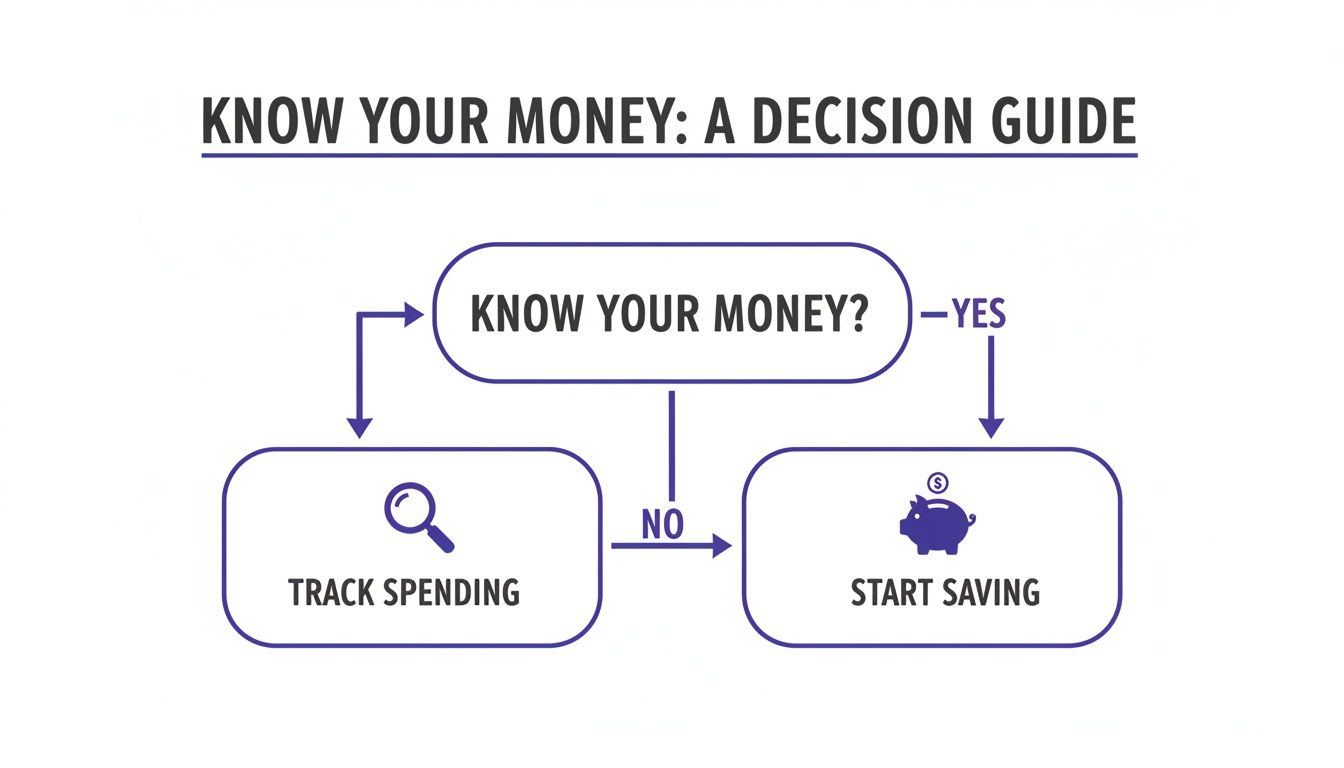
This little chart nails it. The path to saving always starts with awareness. If you don't have a clear picture of your finances, you can't really plan for the future. You have to know where you are to get where you want to go.
Find Your Budgeting Style
Canadians have a few favourite ways to manage their money. Let's look at a couple of popular ones to see which might feel right for you.
A fantastic starting point for many is the 50/30/20 rule. It’s a simple, no-fuss framework that splits your after-tax income into three buckets:
- 50% for Needs: This is the non-negotiable stuff. Think rent or mortgage, utilities, groceries, transportation, and minimum debt payments.
- 30% for Wants: This is the fun stuff that makes life worth living but isn't strictly essential. It could be dining out, hobbies, streaming services, or that weekend trip to Muskoka you’ve been dreaming of.
- 20% for Savings & Debt Repayment: This is where you build your future. It’s for your emergency fund, TFSA or RRSP contributions, and any extra payments you make to zap high-interest debt.
The best part? It's simple and flexible. It gives you clear guardrails without making you track every last coffee.
A budget is telling your money where to go instead of wondering where it went. By proactively assigning your income to different categories, you take back control and ensure you're making progress on what matters most.
For those who crave a bit more control, there's zero-based budgeting. This method is exactly what it sounds like: you give every single dollar a purpose. At the end of the month, your income minus all your expenses (including savings) should equal zero.
It takes more attention to detail, but it's incredibly powerful for finding and cutting out financial waste. It forces you to justify every single expense, which can be a huge eye-opener. If you’re a gig worker in Toronto with a different paycheque every month, this can be a lifesaver for adapting your spending on the fly.
How Different Budgeting Methods Stack Up
Picking the right strategy really comes down to your personality, how stable your income is, and what you’re trying to achieve. There’s no single "best" way, only the best way for you.
Here’s a quick comparison to help you find your fit.
Popular Budgeting Methods for Canadians Compared
| Budgeting Method | Best For | How It Works | Potential Drawback |
|---|---|---|---|
| 50/30/20 Rule | Beginners and anyone who wants a simple guideline without obsessive tracking. | Divides after-tax income: 50% for needs, 30% for wants, and 20% for savings/debt. | Might be too broad if you have complex finances or really aggressive savings goals. |
| Zero-Based Budgeting | Detail-oriented folks, people with irregular incomes, or anyone aiming to maximize every dollar. | Every dollar of income is assigned a job (spending, saving, debt), leaving a zero balance. | Can be time-consuming to set up and manage each month without the right tools. |
| Pay Yourself First | Savers who prefer a hands-off approach to day-to-day spending. | On payday, a set amount is automatically transferred to savings before any other bills get paid. | Doesn't tackle overspending in other areas, which can undermine your savings efforts. |
No matter which path you take, the key is to choose one and get started. You can always adjust as you go.
Make Budgeting Effortless with Technology
Whichever method you land on, consistency is what separates success from failure. This is where modern tools can be a total game-changer, turning a tedious chore into an automated, stress-free habit.
An app like NeoSpend is built for exactly this. Its AI can peek at your past spending from your connected Canadian accounts and automatically suggest budget categories for you. It learns your patterns and can even ping you with a smart alert when you’re about to overspend on groceries or entertainment.
This means you can stay on track without having to manually check in all the time. It turns budgeting from a reactive task into an effortless part of your financial routine, helping you save money in Canada more effectively than you ever thought possible.
Automate Your Savings and Reach Your Goals Faster
Let's be real: the most effective way to save money isn't about having iron-clad willpower. It’s about setting up a system that does the heavy lifting for you. The single best habit you can build is to automate your savings, taking the daily "should I save or should I spend?" decision right out of the equation.
This is the classic ‘pay yourself first’ strategy, and it’s a game-changer. Instead of trying to save whatever’s left at the end of the month (which, for most of us, is basically pocket lint), you flip the script. You prioritize your savings from the get-go.
By setting up automatic transfers, your savings goals become just as important as your rent or hydro bill. It's a fixed expense, a non-negotiable part of your financial routine. This way, you’re consistently building wealth without even thinking about it.
Set Up Your Automatic Savings System
Getting this up and running is way easier than you think. You can do it in a few minutes from your online banking app. The whole point is to create a seamless flow of money from your chequing account to your savings every single payday.
Here’s how to get it done:
- Pick a Destination: First, decide where the money is going. For short-term goals or an emergency fund, a High-Interest Savings Account (HISA) is your best bet. For the long game—like retirement or a down payment—a Tax-Free Savings Account (TFSA) is usually the way to go for that sweet tax-free growth.
- Log In to Online Banking: Head to the "Transfers" or "Payments" section of the bank account where your paycheque lands.
- Schedule the Transfer: Look for an option to set up a recurring or automatic transfer. Set the frequency to match your pay schedule (bi-weekly, monthly, whatever it is) and schedule it for the day after you get paid. This is key—the money is gone before you even have a chance to miss it.
For example, if you get paid on the 15th and 30th of each month, you could set up an auto-transfer of $100 to your TFSA on the 16th and the 1st. It feels small, but that consistent action builds serious momentum.
How Much Should You Automate?
Okay, so what’s the magic number? You don’t want to send so much that you’re scrambling for cash before your next paycheque, but you need to be ambitious enough to see real progress.
Take a look at the budget you worked on earlier. If you’re a fan of the 50/30/20 rule, your target is 20% of your after-tax income. But if that feels like a huge stretch right now, don't sweat it.
The most important thing is to start with an amount that feels comfortable, even if it’s just $25 per paycheque. Building the habit is more important than the dollar amount at first. You can—and absolutely should—increase it later.
Once you have a few months of automated savings under your belt, try bumping it up by 1%. If your take-home pay is $4,000 a month, that's just an extra $40. You probably won't even feel that small of a change, but it adds up big time over the year.
Link Your Savings to Specific Goals
Saving money can feel like a chore until you know why you're doing it. Instead of just dumping money into one big savings account, create separate goals and link your automated transfers to them. It gives you clarity and makes it way more motivating to watch your progress.
This is where a tool like NeoSpend really shines. Inside the app, you can create and name specific savings goals, like:
- Emergency Fund: Your safety net. Aim for 3-6 months of essential living costs.
- Vacation to Banff: Figure out the cost and give yourself a deadline.
- New Car Down Payment: Set a clear target, like $8,000.
NeoSpend lets you watch how your automated deposits are chipping away at each goal, turning an abstract idea into something you can actually see and feel.
When saving becomes an automated, default action tied to things you're genuinely excited about, you take all the effort and emotion out of it. You’re not relying on discipline anymore; you’re building a system for guaranteed success.
Cut Your Recurring Bills and Subscriptions
Let's be honest, one of the biggest leaks in most Canadian budgets isn't some huge, one-time splurge. It's the slow, silent drain from recurring bills and subscriptions.
That $15.99 streaming service you barely touch, or the gym membership you’ve been meaning to cancel for months? It all adds up, often to hundreds or even thousands of dollars a year. Getting a grip on these automatic payments is one of the fastest ways to free up some serious cash.
The first move is a simple but powerful audit. You have to know exactly what you're paying for every single month. So many of us suffer from ‘subscription fatigue,’ where we sign up for things and then just… forget.
This is where a tool like NeoSpend becomes your financial watchdog. Hook up your accounts, and it automatically flags all those sneaky recurring payments. Suddenly, you have a clean list of every single subscription, taking all the detective work out of figuring out where your money is going on autopilot.
Your Tactical Subscription Audit
Okay, you’ve got your list. Now it's time to get a little ruthless. Go through each item, one by one, and ask yourself some tough questions:
- When was the last time I actually used this? If it’s been more than a month, it should be on the chopping block.
- Does this service bring me real value or joy? Seriously. Does that niche app truly make your life better, or is it just… there?
- Is there a cheaper (or free) way to get this? Think about it: could you borrow e-books from your local library instead of paying for that audiobook subscription?
Cancelling is usually a breeze—most services let you do it online in just a few clicks. Here's the key: for every subscription you cut, immediately set up an automatic transfer for that same amount into your savings account. That way, you actually feel the win.
Negotiate Your Way to Lower Bills
Beyond subscriptions, your big-ticket monthly bills—I’m talking phone, internet, and insurance—are almost always negotiable. Companies across Canada have better deals and loyalty discounts hiding in the back, but they almost never offer them up unless you ask. A single phone call can often shave $20 to $50 off your monthly total.
The trick is to be prepared and polite. Before you dial, do a quick search for what their competitors are offering new customers. This is your leverage.
When you call, try a simple script like this:
"Hi, I've been a loyal customer for a few years, and I'm finding my latest bill is a bit high. I’ve noticed that [Competitor Name] is offering a similar plan for [Price]. I’d really prefer to stay with you, but I need a more competitive rate. Is there anything you can do to help lower my monthly bill?"
This approach is friendly but firm. It shows you’ve done your homework and aren't afraid to walk. More often than not, they’ll find a discount or switch you to a better plan just to keep your business.
The Power of Bundling and Annual Payments
Here’s another great Canadian savings strategy: look for bundling opportunities. Many providers will give you a major discount if you combine services like your internet, mobile phone, and TV with them. If your services are scattered across different companies, it's definitely worth checking if consolidating could save you money.
Also, think about switching to annual payments for services you know you’ll keep, like car insurance or certain software. Companies love getting paid upfront and often offer a 10-15% discount for it. Just make sure you have the cash set aside in your budget to cover the lump-sum payment.
Keeping track of all these moving parts—renewal dates, price hikes, and negotiation opportunities—can feel like a full-time job. That’s why having a solid bill tracking feature is a game-changer.
A tool like NeoSpend helps you stay ahead of the curve. It doesn’t just show you what you’ve already paid; it alerts you to upcoming bills and can even spot if a provider has quietly jacked up your rate. This gives you the intel you need to take action, whether that's cancelling a service you don't need or calling your provider to get a better deal. You're no longer just reacting—you're proactively keeping more of your hard-earned money.
Use Canadian Tax and Savings Accounts to Your Advantage
Saving money in Canada isn't just about cutting back on lattes; it’s about making your money work smarter, not just harder. The Canadian financial system has some incredibly powerful tools designed to help your savings grow, and getting to know them can seriously speed up your journey to your goals.
The two heavyweights you absolutely need to know are the Tax-Free Savings Account (TFSA) and the Registered Retirement Savings Plan (RRSP). Don't let the names intimidate you. Their purpose is actually pretty simple: help you build wealth by shielding your money from the taxman.

TFSA vs. RRSP: Which One Is Right for You?
Think of these accounts as special containers for your savings and investments. The government gives these containers unique tax perks, but which one you should use really depends on your income, what you're saving for, and when you'll need the cash.
A TFSA is a master of flexibility. You put in after-tax money, but once it's in there, every penny of growth—from interest or investments—is yours to keep, completely tax-free. Forever. You can pull money out anytime for any reason without a tax penalty, and you get that contribution room back the next calendar year.
Say you put $7,000 (the 2024 limit) into your TFSA and it grows to $8,000. If you need that cash for a down payment, you can withdraw the entire $8,000 and not owe a single cent in taxes. It’s that good.
The TFSA is often the best starting point for most Canadians, especially if you have a lower-to-moderate income or need your money to be accessible. Its tax-free withdrawal feature makes it perfect for an emergency fund, a down payment, or any other major savings goal.
An RRSP, on the other hand, is built for the long haul—specifically, retirement. Its biggest selling point is the upfront tax break. Every dollar you contribute can be deducted from your taxable income for the year, which usually means a nice tax refund comes spring. Your money then grows tax-deferred until you start taking it out in retirement.
This makes the RRSP a no-brainer for people in their prime earning years. If you're in a high tax bracket now, contributing to an RRSP lowers your current tax bill. The idea is that you'll withdraw the funds in retirement when your income (and tax bracket) is likely much lower.
Making the Smart Choice
So, where should you put your money first? Here’s a quick cheat sheet to help you decide.
Go with the TFSA if:
- You're in a lower income tax bracket.
- You think you might need the money before you retire.
- You've already contributed enough to your RRSP to get the full employer match (if you have one).
- You’re building an emergency fund or saving for a goal within the next few years.
Lean towards the RRSP if:
- You’re in a middle-to-high income tax bracket and the tax deduction is a big win for you.
- Your employer offers a matching program—this is free money, and you should never, ever pass it up!
- You have the discipline to leave the funds untouched until retirement.
Don’t Forget About Government Benefits
Beyond these accounts, make sure you're getting all the government benefits you're entitled to. This is literally money being left on the table. So many Canadians miss out simply because they don't apply or don't realize they qualify.
We're talking about programs like the Canada Child Benefit (CCB) for parents and the GST/HST credit for people with low-to-modest incomes. The only way to get these is to file your taxes on time, every single year.
Getting a handle on these systems is a core part of a solid savings strategy in Canada. It's about playing the long game and using the tools available to make every dollar you save work as hard as you do. A platform like NeoSpend can be a great ally here, helping you track your contributions and making sure you’re taking full advantage of the room you have in each account.
Your Top Money Questions, Answered
Let's face it, trying to get your finances in order brings up a ton of questions. Here are some real-world answers to the things Canadians ask most when they're figuring out how to save money.
What's the Fastest Way to Build an Emergency Fund in Canada?
You need a two-pronged attack: a short, intense sprint followed by a consistent marathon pace.
First, go on a strict but temporary spending diet for one to three months. Find your top three spending weaknesses—maybe it’s takeout, online shopping, or your morning coffee run—and funnel every single cent you would have spent into a high-interest savings account (HISA). It's a short-term sacrifice for a huge head start.
At the same time, set up an automatic transfer to that HISA for every payday. Even if it's just $25 a week to start, the key is making it automatic. This combo of a quick cash injection and a new automated habit works wonders. An app like NeoSpend can show you exactly where that extra cash is hiding and let you watch your fund grow in real time.
How Much Should I Actually Be Saving Each Month?
You've probably heard of the 50/30/20 rule, which suggests saving 20% of your take-home pay. That's a great goal, but with today's cost of living, it's just not realistic for many of us right out of the gate.
A much better approach? Start with a manageable 5-10% and focus on consistency above all else.
The goal isn't to hit some magic number overnight; it's to build the habit of paying yourself first. Once you see where your money is actually going, you can start making small tweaks and slowly bump up that percentage. You want to make progress without feeling like you have to give up everything you enjoy.
Should I Pay Off Debt or Save Money First?
For most Canadians, the answer is to do both at the same time, but with a laser focus on one over the other.
If you have high-interest debt—think credit cards with rates over 8%—that needs to be your top priority. The interest you're paying is almost guaranteed to be higher than anything you could earn on your savings or investments. It’s like trying to fill a bucket with a hole in it.
While you're aggressively tackling that debt, it's still smart to build a small starter emergency fund of $500-$1,000. This little buffer can keep a small emergency, like a flat tire, from becoming new credit card debt. For lower-interest debts like a mortgage or student loan, it usually makes sense to stick to your regular payments while also contributing to your TFSA or RRSP.
How Is an App Like NeoSpend Better Than a Spreadsheet?
A spreadsheet is a great tool, but it's completely manual. You have to remember to input every single coffee, grocery run, and bill payment. It’s tedious, and it's incredibly easy to forget things, which means you're never working with the full picture.
NeoSpend puts all of that on autopilot. It securely links to your Canadian bank accounts, giving you a live, up-to-the-minute view of your finances without any of the manual work.
Its AI-powered system automatically categorizes your spending, shows you where your money is really going, and sends you smart alerts about things like upcoming bills or subscriptions you might have forgotten about. It turns managing your money from a chore you dread into an easy, insightful habit. A spreadsheet just can't do that.
Key Takeaway: The secret to saving money in Canada isn't about drastic sacrifices; it's about building a smart system. Start by understanding where your money goes, create a flexible budget that fits your life, and automate your savings. Small, consistent actions are what build real, long-term wealth.
Ready to stop guessing and start knowing where your money is going? NeoSpend gives you the clarity to build a budget you can stick to, automate your savings, and actually reach your financial goals.
Learn more and see how NeoSpend can help you take control at https://neospend.com.