Let's be real for a moment. The fastest way to save money is to stop spending it on things you don't actually need. The secret isn't some complex financial formula; it's about finding your financial leaks right now and plugging them, fast.
This guide provides a clear, practical game plan for Canadians to free up cash within the next 24-48 hours. We'll skip the jargon and give you actionable steps to see an immediate impact on your savings.
Your Action Plan to Find Savings Right Now

When you're under pressure to find extra cash, just knowing where to start can feel overwhelming. The goal here isn't a massive overhaul of your entire financial life overnight. It's about making a few smart, strategic moves that have an immediate impact. Think of it as building momentum—these small wins make the bigger changes feel much less intimidating.
We're going to zero in on three key areas: uncovering where your money is really going, challenging your spending habits, and trimming down your fixed costs. It’s like financial triage—we’re stopping the bleeding first to get things stable.
Get a Clear Picture of Your Spending—Immediately
You can't cut costs if you don't know where your money is going. This isn't about feeling guilty over past purchases; it’s a pure fact-finding mission. You’d be amazed at how many Canadians find hundreds of dollars a month just slipping away through small, seemingly harmless transactions.
This is where a tool like NeoSpend becomes your secret weapon. By securely linking your bank accounts and credit cards, it automatically categorizes every transaction. In minutes, you can see exactly how much you spent on groceries at Loblaws, those morning coffees at Tim Hortons, or your late-night SkipTheDishes habit. That data is your roadmap to quick savings.
A spending audit isn't about setting up a restrictive budget that makes you miserable. It's about gaining awareness. You simply can't change what you don't measure, and seeing your spending laid out clearly is often the most powerful motivation for change.
Once you have this overview, look for patterns. Do you spend more on certain days? Are there subscription services you completely forgot you were paying for? Pinpoint the top three categories where you can realistically make a cut, starting today.
Negotiate Your Monthly Bills
So many of our recurring bills—your mobile phone, internet, and even some insurance premiums—feel like they're set in stone. They're not. Companies would much rather give a loyal customer a bit of a discount than lose them to a competitor. A single phone call can often lead to some serious monthly savings.
Before you dial, do a little homework. Hop onto a competitor's website and see what kind of deals they're offering new customers. This gives you solid leverage when you make the call.
Here’s a simple script you can adapt for a typical Canadian provider:
- You: "Hi there, I've been a customer for [number] years, and I'm just reviewing my monthly expenses. My current internet bill is [amount], which is a bit higher than I'd like. I've seen that [Competitor] is offering a similar plan for [lower amount]. I'd really prefer to stay with you, but I need a more competitive rate. Is there anything you can do to help lower my bill?"
The key is to be polite but firm. If the first person you speak with can't help, politely ask to be transferred to the retention or loyalty department. They usually have more power to offer discounts. Shaving even $20-$30 per month off a couple of bills adds up to hundreds of dollars a year.
Kick Off a Short-Term Spending Freeze
A "no-spend" challenge is one of the most powerful ways to reset your spending habits and find savings fast. For a short period—say, a weekend or even a full week—you only spend money on absolute necessities like groceries, essential bills, and gas to get to work.
This little exercise forces you to get creative and breaks the cycle of mindless, convenience-based spending.
- For entertainment: Instead of the movies, check out a local park, grab a book from the public library, or have a board game night at home.
- For food: Challenge yourself to cook meals using only what you already have in your pantry and freezer. You'll be surprised at what you can come up with.
- For shopping: Unsubscribe from those tempting marketing emails and avoid browsing online stores just for fun. Out of sight, out of mind.
The point isn't to deprive yourself forever. It's a short sprint that proves you have control, builds your savings muscle, and instantly frees up cash that you would have otherwise spent without a second thought.
Your 24-Hour Savings Kickstart Checklist
| Action Item | Potential Savings (Monthly) | Effort Level |
|---|---|---|
| Brew coffee at home instead of buying it | $60 - $120 | Low |
| Cancel one unused streaming service | $15 - $25 | Low |
| Pack your lunch for the week | $80 - $200 | Medium |
| Call to negotiate your mobile/internet bill | $20 - $50 | Medium |
| Plan meals around what's already in your pantry | $50 - $150 | Medium |
| Do a "no-spend" weekend (essentials only) | $100 - $300 | High |
Pick one or two of these to get started. The goal is progress, not perfection. Every little bit you save today builds momentum for tomorrow.
Kickstart Your Savings with a 7-Day Sprint
Now that you’ve plugged the most obvious leaks in your finances, it’s time to build real momentum with a 7-day savings sprint. Think of it less like a long-term diet and more like a one-week, high-intensity reset. The goal isn’t deprivation; it’s about proving to yourself just how much control you really have over your cash flow.
It’s a challenge designed to break those autopilot spending habits and build up your confidence. For just one week, you’ll be incredibly intentional with every dollar, creating a ripple effect that can last for months.
Day 1 & 2: Master Your Meals
Let's be honest, the first battleground for most budgets is food. That morning coffee, the "I'm too tired to cook" pizza delivery—it all adds up, and it adds up fast. So for the first two days, your mission is simple: spend zero dollars on food outside of your planned groceries.
That means brewing your own coffee and packing a lunch. But before you even think about hitting the grocery store, "shop" your own kitchen. Dig through the pantry, the fridge, the freezer. You’ll be surprised at what you find. Build your meal plan around what you already own to slash that shopping list from the get-go.
When you do go for groceries, get strategic. Use an app like Flipp to price-match at places like Real Canadian Superstore, or build a few meals around the flyer deals at Sobeys. If you’ve been collecting PC Optimum points, now’s the time to cash some in. The goal here is simple: spend as little as possible and absolutely no eating out.
Day 3 & 4: The Subscription Purge
Day three is all about tackling those sneaky recurring payments. We’ve all done it—signed up for a free trial and completely forgotten to cancel, or held onto services we barely touch anymore. It's time for an audit.
Pop open your banking app or log into NeoSpend and pull up all your recurring transactions. Now, get ruthless. For every single one, ask yourself:
- Am I using this every week?
- Can I find this content for free somewhere else (hello, public library and YouTube)?
- Is there a cheaper option out there?
You might be paying for Crave, Netflix, and Disney+. Could you get by with just one for a few months and rotate? A recent study showed most Canadians seriously underestimate what they spend on subscriptions. Don't be one of them.
On day four, let's look at the bigger fish: your mobile phone plan. So many of us are paying for way more data than we actually use. Check your average monthly usage. You might find you can switch to a much more affordable plan with a flanker brand like Fido, Koodo, or Virgin Plus, which often have better deals than their parent companies.
Here's the thing: This sprint isn't just about cutting costs. It's about forcing yourself to re-evaluate what you actually value. You might find you don't miss that daily latte or the extra streaming service nearly as much as you thought.
Day 5, 6 & 7: Find Free Fun and Track Your Wins
Heading into the weekend, the urge to spend on social events can be powerful. Your final challenge is to have a great time without spending a dime. And luckily, Canada is packed with free options.
- Explore a local conservation area or find a new hiking trail in a nearby provincial park.
- Check your city's event calendar—there's almost always a free festival, outdoor concert, or community market happening.
- Keep it simple. Host a potluck or a board game night with friends instead of hitting a restaurant or bar.
This is also the moment to celebrate your progress. A tool like NeoSpend makes this part easy. Instead of squinting at a spreadsheet, you can just open the app and see the impact in real-time. There’s something incredibly satisfying about seeing your "Restaurants" and "Entertainment" spending categories sitting at or near $0.
Watching your bank account hold steady—or even grow a little—over the week is the best motivation there is. It's proof that you can do this, and it’s the spark you need to turn these short-term tactics into lasting habits. You’ll see exactly how small, focused changes are the real secret to saving money fast.
A 30-Day Roadmap for Sustainable Fast Savings
So, you’ve just blitzed through a high-intensity savings sprint. What now? The next step is turning those quick wins into habits that stick around for the long haul. A 30-day plan isn't about pinching every penny; it's about building a smart, repeatable system that saves you money almost on autopilot.
By carving the month into weekly focus areas, you can make some serious changes without getting overwhelmed. This is how you move from short-term fixes to long-term financial health, making sure the progress you nail this month keeps paying off.
Week 1: Get Total Clarity by Tracking Everything
Consider this week a fact-finding mission. Your only goal is to track every single dollar that leaves your accounts. No judgment, no guilt. This isn't about scolding yourself for that latte; it's about getting an honest, complete picture of where your money is actually going.
For Canadians, that means logging everything from your morning Tim Hortons run and your PRESTO or Compass Card top-up to your weekly grocery haul at No Frills. You’d be shocked to learn how many people find that 15-20% of their monthly income just vanishes into small, untracked purchases.
This is where an app like NeoSpend is an absolute game-changer. It automates this process by categorizing your spending as you go, saving you from manual tracking. By the end of this week, you’ll have a crystal-clear, data-driven view of your financial habits, empowering you to make smarter moves in the weeks ahead.
Week 2: Tame Your Biggest Expenses
Armed with a full week of data, you can now zero in on the areas that’ll give you the most bang for your buck. Week two is all about optimizing your major spending categories—which for most of us means groceries, transportation, and housing-related bills.
For groceries, this could be as simple as planning meals around the weekly flyers from stores like Loblaws or Sobeys and actually sticking to your list. When it comes to transportation, run the numbers: would a monthly transit pass save you money over daily fares? Could you plan your errands more efficiently to cut down on gas?
This isn't about making massive sacrifices, like selling your car tomorrow. It’s about finding smarter efficiencies. Trimming just 10% from your top three spending categories can easily free up hundreds of dollars a month without torpedoing your lifestyle.
This quick flow shows how a few simple, high-impact actions from a savings sprint can create a foundation you can build on.
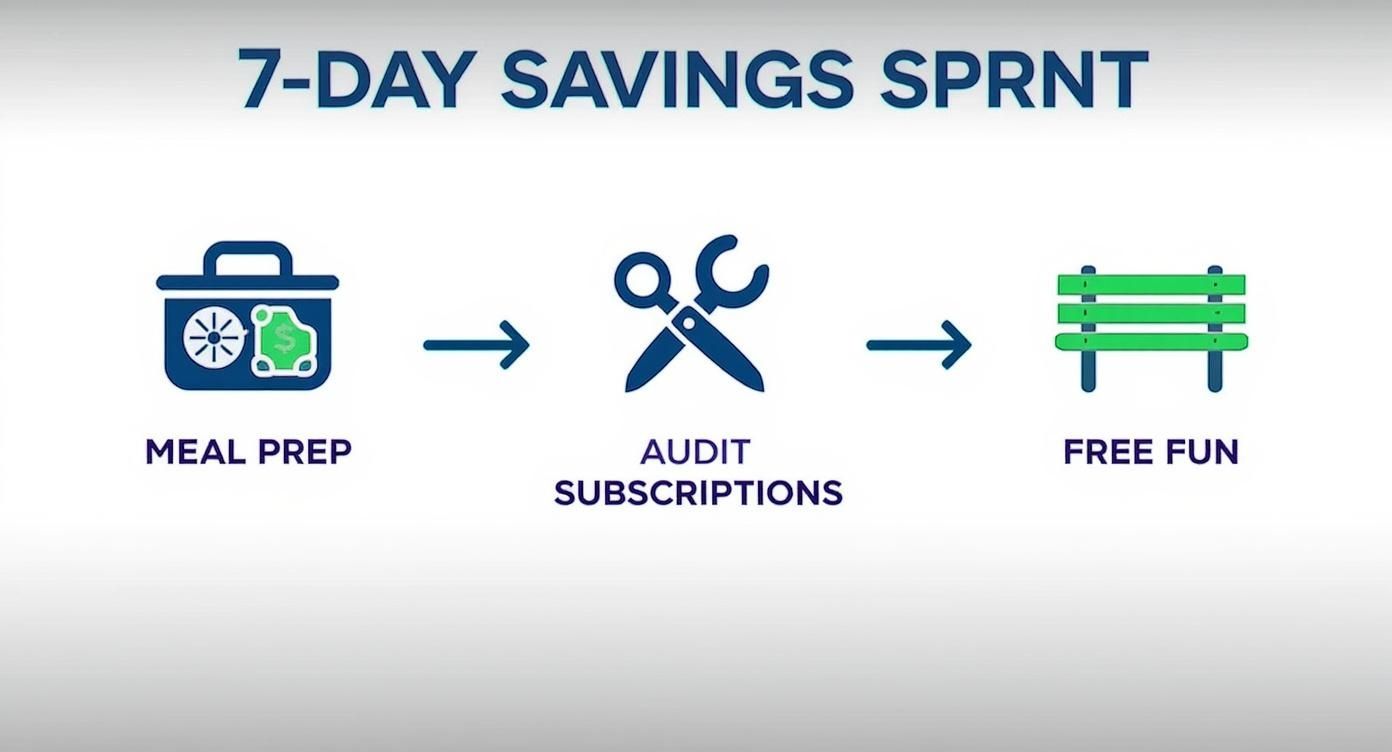
As the visual shows, it’s the simple, focused actions like meal prepping and auditing subscriptions that build real savings momentum.
Week 3: Put Your Financial Future on Autopilot
It’s time to make your savings system work for you, not the other way around. Week three is all about taking the daily decision-making out of the equation. The most effective way to save money is to make it disappear before you even have a chance to spend it.
Here are a few key moves to set up your 24/7 financial machine:
- Pay Yourself First: This is non-negotiable. Set up an automatic transfer from your chequing to a high-interest savings account (like a TFSA) for the day after you get paid. Even if you start small with $50 or $100 per paycheque, you're building a powerful habit.
- Turn on Smart Savings: Inside NeoSpend, you can activate features like 'Roundups'. It automatically rounds up every purchase to the nearest dollar and sweeps the spare change into savings. It feels like nothing, but you'll be stunned by how fast it adds up.
- Automate Debt Payments: If you’re tackling high-interest debt, switch to automatic bi-weekly payments instead of one monthly one. You’ll sneak in an extra full payment each year, saving you a bundle in interest and getting you out of debt faster.
By the end of this week, your savings and debt-reduction plans will be humming along in the background, working toward your goals without you having to lift a finger.
Week 4: Review, Tweak, and Set Your Next Target
In the final week, you get to step back and admire your work—and plan your next move. Look back at your spending from the start of the month. How much did you manage to stash away? Which changes felt easy, and which ones were a struggle?
Use that knowledge to map out a realistic budget for next month. NeoSpend can help by pre-filling budget categories based on your actual spending, which makes setting achievable targets way easier.
This review isn't just about crunching numbers; it's about celebrating the win and building confidence. You’ve just proven to yourself that you can take control of your finances. Now you can set a new, bigger goal—whether that's saving for a down payment, killing off a credit card, or finally building that emergency fund. This 30-day roadmap is just the beginning.
Put Your Savings on Autopilot with Technology

Let's be honest. The biggest thing standing between you and your savings goals isn't your paycheque or your bills—it's willpower. Trying to make the right choice day after day is just plain exhausting.
This is where the most successful savers have a secret weapon: they take the decision-making out of the equation entirely. They let technology do the heavy lifting.
Automating your savings is how you build consistency. It’s the ultimate "set it and forget it" strategy that guarantees you’re always paying yourself first. Suddenly, hitting your financial goals goes from a daily struggle to a background process that just happens.
Create Budgets That Actually Work
Traditional budgeting can feel like a chore—a strict financial diet you're destined to fall off. Modern tools completely flip that idea on its head. Forget the rigid spreadsheet; we’re talking about dynamic, flexible spending plans that actually adapt to your life.
With an app like NeoSpend, you can create custom budgets for different categories in minutes. It analyzes your real spending habits—your grocery runs to Metro, your gas fill-ups at Petro-Canada—and helps you set targets that make sense for you. No more guesswork. It’s all based on your own data.
You’ll even get smart alerts when you're getting close to your limit in a category. It's a friendly nudge, not a scolding, helping you stay on track without feeling deprived. This is one of the smartest ways to save money fast without having to overhaul your lifestyle.
The Magic of Saving Your Spare Change
One of the most powerful tricks in the book is the digital version of a change jar, only way more effective. Every time you make a purchase, the app rounds the amount up to the nearest dollar and squirrels away the difference into your savings.
Here’s how it works in a typical Canadian scenario:
- That morning coffee for $2.75? It gets rounded up to $3.00, and $0.25 is automatically saved.
- Filling up the tank for $68.40? It rounds to $69.00, and $0.60 lands in your savings.
This feature, often called 'Roundups' in apps like NeoSpend, makes saving completely painless. You'll never miss those few cents, but they add up incredibly fast. It’s not a stretch for people to save hundreds of dollars a year this way, all without a single conscious thought.
Automation transforms saving from an active chore into a passive habit. By setting up these systems once, you are making hundreds of good financial decisions in advance, ensuring you consistently move closer to your goals.
This method is brilliant because it piggybacks on the small, frequent things you're already doing. It’s a perfect example of how technology can quietly build positive financial habits for you.
Manual Savings vs Automated Savings with NeoSpend
| Feature | Manual Savings | Automated Savings (NeoSpend) |
|---|---|---|
| Consistency | Relies entirely on willpower and memory. | Automatic and consistent; no effort required. |
| Budgeting | Often involves manual tracking with spreadsheets. | Dynamic budgets based on real spending with smart alerts. |
| Micro-Savings | Impractical; who has time to track spare change? | 'Roundups' save spare change from every purchase. |
| Timing | You have to remember to transfer money yourself. | "Pay Yourself First" with scheduled, automatic transfers. |
| Effort | High. Requires constant attention and discipline. | Low. Set it up once and let it run in the background. |
The difference is night and day. One path is full of friction and requires constant effort, while the other puts your progress on cruise control.
Schedule Recurring Transfers to Pay Yourself First
This is the bedrock of any solid savings plan: "pay yourself first." It means your savings contribution isn't what's left over at the end of the month; it’s the very first "bill" you handle when your paycheque hits.
Automation makes this principle foolproof. Simply schedule a recurring transfer from your chequing account to a dedicated savings account (a high-interest one, like in a TFSA, is ideal). Set it for the day after you get paid. The money is moved before you even see it, let alone get tempted to spend it.
Start small if you need to—even $25 or $50 a paycheque makes a difference. The goal here is to build the habit. Once you get into the rhythm, you can start bumping that number up as you find more room in your budget.
When you combine smart budgets, automatic Roundups, and scheduled transfers, you’re not just saving—you're building a powerful, multi-layered system that works for you 24/7.
Savings Strategies for Every Type of Canadian

Let’s be honest: a cookie-cutter approach to saving money is doomed from the start. A university student’s financial world in Halifax looks nothing like a freelance designer’s in Calgary, which is completely different from a young family’s in suburban Toronto. To actually save money fast, your plan has to be built for your life.
This is all about finding tactics that click with your specific challenges and goals. Whether you’re staring down student loan payments, riding the wave of an unpredictable income, or mapping out your family's future, the right approach makes all the difference.
Smart Savings for Students
Life as a student can feel like a constant financial juggle. You’ve got tuition, books, and living costs, probably a part-time job, and you're still trying to have some kind of social life. The secret is to build small, consistent habits that don't feel like a burden.
Start by treating your savings like any other bill you have to pay. Even if it's just $20 per paycheque from your campus job, get that transfer automated into a separate account. This is where you build the muscle memory of saving. A tool like NeoSpend makes this easy, letting you set up those automatic transfers and even use ‘Roundups’ to tuck away spare change from your daily coffee runs without a second thought.
Your student years are the perfect time to build a strong financial foundation. The habits you form now—tracking spending, avoiding unnecessary debt, and saving consistently—will pay massive dividends for the rest of your life.
Also, become an expert on student discounts. Your student ID is basically a money-saving superpower. From transit passes and software to movie tickets and groceries on certain days, these little savings add up incredibly fast. Use it everywhere.
Financial Fitness for Freelancers and Gig Workers
The freedom of freelance life is amazing, but it comes with a built-in challenge: feast-or-famine income. One month you’re killing it, and the next feels like a ghost town. The key to surviving and thriving is to smooth out those peaks and valleys.
When you land a big payment, fight the urge to immediately upgrade your lifestyle. Instead, get into a "profit first" mindset. The very first thing you do when money hits your account is slice it up and send it where it needs to go:
- Taxes: Immediately move 25-30% of every single invoice into a separate account for the Canada Revenue Agency (CRA). This is non-negotiable. Trust me, you'll thank yourself come tax season.
- Savings: Send another 10-20% straight to your personal savings or investment accounts, like a TFSA or RRSP. Pay yourself before you pay anyone else.
- Business Expenses: Keep a smaller percentage aside for the tools of your trade—software, equipment, or professional development.
With NeoSpend, you can create custom budgets that mirror this exact strategy. By tagging different income sources and business expenses, you get a crystal-clear picture of your actual profitability and can prepare for tax time without the usual panic.
Building Wealth for Canadian Families
For families, saving is a constant balancing act between today's needs and tomorrow's dreams. You're juggling a mortgage, childcare, groceries, and everything in between, all while trying to get ahead. Efficiency is your new best friend.
Zero in on the "big three" expenses: housing, transportation, and food. Switching to a bi-weekly mortgage payment schedule, for instance, can knock years off your loan and save you thousands in interest. When it comes to groceries, a little planning goes a long way. Building your weekly menu around the sales flyers from stores like Sobeys or Loblaws can easily free up $200-$300 a month.
Looking ahead, make your kids' education a top priority. Opening a Registered Education Savings Plan (RESP) is one of the smartest things you can do. The government kicks in a grant (the CESG) that matches 20% of what you contribute, up to $500 per year. That’s free money for your child's future. You can set up automatic contributions to an RESP right from NeoSpend, making sure you never miss out on getting that full grant.
A Few Common Questions About Saving Money Fast
Deciding to kickstart a savings plan is a great first step, but it's totally normal for a bunch of questions to pop up along the way. You might wonder if you're doing things right or how to navigate those tricky financial crossroads.
Let's tackle some of the most common questions we hear from Canadians who are ready to get serious about saving. The goal here is to give you straightforward, practical answers so you can keep your momentum going.
What Is the Fastest Way to Save $1000 in Canada?
Getting to that first $1,000 fast is all about a two-pronged attack: aggressively cut your spending and find ways to bring in extra cash. Doing both at once is the secret sauce.
First, go on a spending diet for anything that isn't a true necessity. We're talking about pausing subscriptions, becoming your own personal chef for a while, and checking out free community events instead of pricey nights out.
At the same time, hunt for some quick income boosts. Can you sell that old gaming console or bike on Kijiji? Could you pick up a few delivery shifts with a gig app? Maybe you have a skill you can offer to your network as a freelancer.
This is where a tool like NeoSpend really shines. It helps you see the impact of your spending cuts and track that extra income as it comes in, all in one place. It’s like having a live scoreboard for your $1,000 goal.
Should I Pay Off Debt or Save Money First?
Ah, the classic question. For most Canadians, the answer almost always boils down to a simple bit of math: interest rates.
If you’re staring down high-interest debt, like a credit card that’s charging you 19.99% or more, that should be your number one enemy. The interest you’re paying is a guaranteed loss that will almost certainly outpace any gains you could make in a savings account. Wiping out that debt saves you more money in the long run.
The one big exception? Build a small emergency fund first. Having at least $500 to $1,000 tucked away is a smart move. It’s your buffer against a minor crisis, like a flat tire, that could otherwise send you right back into high-interest debt.
Now, if you're dealing with lower-interest debt like a government student loan or a car loan, you have more flexibility. It's often possible to make your regular payments on those while still building up your savings at the same time.
How Can an App Actually Help Me Save Money Faster?
Think of a financial app like NeoSpend as your savings sidekick. It automates the good habits you're trying to build and clears up the fog around your finances, taking the daily grind and guesswork out of the picture.
Smart automation is its biggest superpower. Features like 'Roundups' are a perfect example—they sweep the spare change from your daily purchases into savings. You'll never miss those few cents, but they can easily add up to hundreds of dollars over a year without you even trying.
Plus, you can set up recurring transfers to your savings account, which basically puts the "pay yourself first" rule on autopilot. The app does the heavy lifting to build that consistent saving muscle for you, making sure you're always moving closer to your goals.
The Takeaway: Saving money fast in Canada starts with small, actionable steps that build momentum. By getting a clear picture of your spending, challenging your monthly bills, and using technology to automate your savings, you can take control of your finances and reach your goals sooner.
Ready to put your savings on autopilot and reach your goals faster? NeoSpend Inc. provides the tools you need to see your finances clearly and save effortlessly. Discover how our smart budgeting features and automated savings can work for you at https://neospend.com.
Article created using Outrank