Understanding the difference between fixed and variable expenses is the first step toward mastering your money. Fixed expenses are the consistent, predictable costs you pay each month or year, like your rent or car insurance premium. They form the stable foundation of your household budget, making financial planning much more manageable.
Unlike variable costs that fluctuate, such as groceries or entertainment, fixed expenses stay largely the same. This predictability is their greatest strength. Knowing exactly what you owe and when allows you to automate payments, forecast your cash flow accurately, and confidently allocate funds toward your savings goals.
This guide provides a comprehensive list with a clear example of fixed expenses across seven essential categories relevant to Canadians. We'll explore everything from mortgage payments in Toronto to car loans in Calgary. More importantly, we'll provide actionable strategies for tracking, managing, and even reducing these recurring costs with tools like NeoSpend. By understanding the core of your budget, you can build a stable financial future and gain complete control over your money.
1. Mortgage or Rent Payments
For the vast majority of Canadian households, the single largest and most predictable monthly outlay is the cost of housing. This makes mortgage or rent payments a cornerstone example of fixed expenses and a critical line item in any budget. Whether it's a mortgage on a Toronto condo or rent for a Vancouver apartment, this payment typically remains constant for a set period, making it a reliable figure for financial planning.
The stability of this expense is its key feature. A homeowner with a fixed-rate mortgage knows their principal and interest payment will not change for the duration of their term, often five years in Canada. Similarly, a renter’s monthly payment is locked in by their lease agreement, usually for one year. This predictability provides a solid foundation upon which the rest of a household's budget can be built.
Strategic Breakdown & Actionable Takeaways
Effectively managing this expense goes beyond simply making the payment on time. It involves strategic planning and tracking to optimize your financial health.
- Track Your Housing-to-Income Ratio: A common guideline suggests housing should not exceed 35% of your pre-tax income. Use a budgeting app like NeoSpend to automatically tag your rent or mortgage payments. This allows you to instantly see what percentage of your income goes toward housing and adjust if the ratio is too high.
- Plan for Renewals Proactively: Canadian mortgages typically renew every 1 to 5 years. This renewal period is a crucial opportunity to secure a better interest rate. Set automated reminders in NeoSpend for your renewal date and start monitoring the Bank of Canada’s interest rate trends at least six months in advance to inform your negotiations.
- Isolate Core vs. Associated Costs: While the core mortgage or rent payment is fixed, associated costs like property taxes or condo fees can change annually. Tagging these expenses separately from your main payment in NeoSpend provides a clearer picture of your total, evolving housing costs.
2. Property Tax and Home Insurance
Beyond the mortgage, Canadian homeowners face two other significant and recurring housing costs: property tax and home insurance. These are a prime example of fixed expenses because they are mandatory, predictable over the short term, and must be factored into any homeowner's budget. Property taxes are levied by municipalities to fund local services, while home insurance is required by mortgage lenders to protect their investment against damage or loss.
While the exact amounts can change annually based on municipal assessments and insurance premium adjustments, they are typically paid in predictable instalments. For example, an Alberta homeowner might budget for $2,200 in annual property tax and $800 in insurance on their $450,000 home, creating a stable, non-negotiable expense. This predictability makes them a fundamental part of a household’s fixed financial commitments.

Strategic Breakdown & Actionable Takeaways
Proactively managing these costs can lead to significant savings and better financial stability. It requires more than just paying the bills; it involves annual reviews and strategic planning.
- Bundle and Shop for Insurance Annually: Insurance loyalty rarely pays off. Use your policy renewal date, which you can track in NeoSpend with an automated reminder, as a prompt to shop for new quotes. Bundling home and auto insurance with a single provider can often unlock savings of 10-15%.
- Understand Your Property Tax Assessment: Your municipal property tax bill is based on an assessed value of your home. If you believe the assessment is too high compared to similar homes in your neighbourhood, you have the right to appeal it. Check your local municipality’s website for the appeal process and deadlines.
- Leverage Tax Credits and Deferrals: Many provinces, like Quebec and British Columbia, offer property tax deferral programs or credits for seniors, veterans, or low-income households. Research your provincial and municipal government websites to see if you qualify for programs that can reduce or postpone this fixed expense.
3. Utilities (Electricity, Gas, Water)
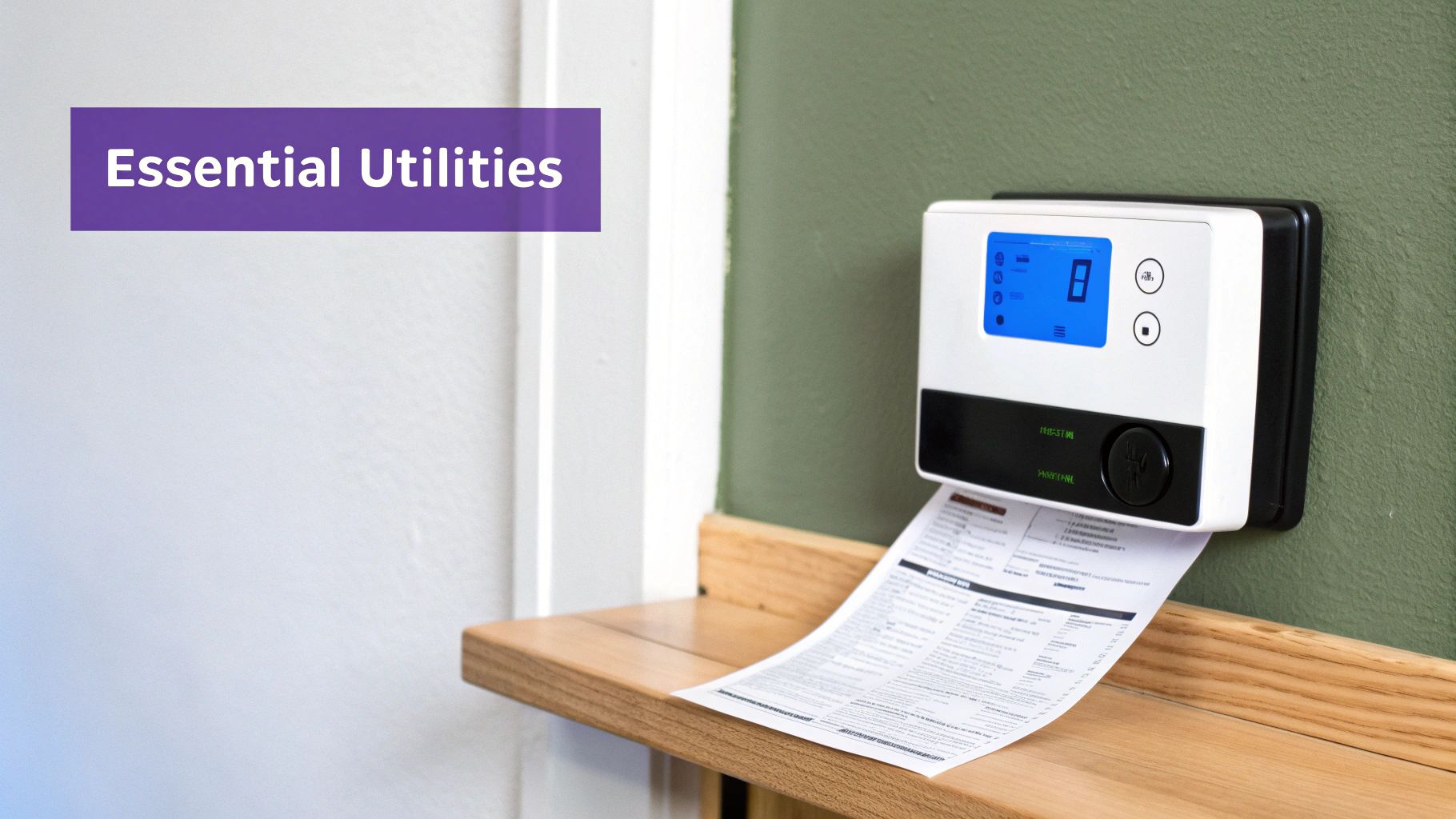
While utility bills like electricity, natural gas, and water often have a variable component based on consumption, a significant portion is predictable enough to be considered a quasi-fixed expense. This makes them another important example of fixed expenses to factor into your financial planning. Most Canadian providers combine fixed base charges for service and delivery with tiered or fixed-rate pricing structures, creating a reliable monthly cost baseline.
The core of this expense, such as the fixed delivery charge from a provider like Hydro-Québec or BC Hydro, remains constant regardless of usage. Additionally, many Canadians opt for equalized payment or budget billing plans. These plans average your estimated annual utility costs into equal monthly payments, transforming a variable expense into a predictable fixed one, which is ideal for simplifying your budget. This stability, whether from base fees or budget billing, is crucial for accurate financial forecasting.
Strategic Breakdown & Actionable Takeaways
Managing utility costs effectively requires more than just paying the bill; it involves understanding your usage patterns and leveraging tools to optimize spending.
- Enroll in Budget Billing: To eliminate seasonal cost spikes, such as high heating bills in a Calgary winter, contact your utility provider to enroll in their budget billing or equal payment plan. This smooths out your monthly cash flow, making your utility payments as predictable as your rent.
- Monitor for Spikes and Inefficiencies: Use a budgeting app like NeoSpend to set up alerts for your utility categories. A notification for an unusually high water bill could be the first sign of a hidden leak, while an electricity spike might indicate an inefficient appliance, prompting a timely and cost-saving fix.
- Analyze and Compare Rate Plans: Your province may offer different rate structures (e.g., tiered, time-of-use, or flat-rate). Use NeoSpend's transaction history to analyze your past consumption patterns. This data will help you determine if switching to a different plan could lower your overall costs.
4. Insurance Premiums (Auto, Life, Disability)
Insurance premiums represent a contractual, recurring payment to protect against significant financial loss, making them a clear example of fixed expenses. For many Canadians, auto insurance is a mandatory monthly or annual cost, while life and disability insurance provide crucial income protection. These payments are predictable and consistent, offering stability to your financial plan.
The fixed nature of insurance premiums makes them an easy line item to budget for. Whether it's a $150 monthly premium for a bundled auto and home policy in Ontario or a $50 monthly payment for a term life insurance policy, this amount remains unchanged for the duration of your policy term, typically one year. This predictability allows you to account for a significant protective expense without worrying about monthly fluctuations.
Strategic Breakdown & Actionable Takeaways
Simply paying your insurance bill isn't enough; strategic management can lead to significant savings and better coverage. Proper tracking and regular reviews are key to optimizing this fixed cost.
- Schedule Annual Policy Reviews: Your insurance needs can change, and so can market rates. Set an automated reminder in your NeoSpend app 45 days before your policy renewal date. Use this time to shop around and get quotes from at least three different providers to ensure you're not overpaying.
- Leverage Deductibles Wisely: A higher deductible typically means a lower premium. If you have a healthy emergency fund, consider increasing your auto or home insurance deductible. Use NeoSpend to model the potential monthly savings versus the increased one-time cost you’d face if you need to make a claim.
- Bundle and Search for Discounts: Insurers often offer discounts for bundling multiple policies (e.g., auto and home), installing safety features like winter tires, or belonging to certain professional organizations. Tag all your insurance payments in NeoSpend under a single "Insurance" category to see your total cost and identify bundling opportunities for potential savings.
5. Loan Payments (Student, Car, Personal)
For many Canadians, loan payments represent a significant and non-negotiable portion of their monthly budget. These contractually obligated payments are a classic example of fixed expenses, as the amount and due date are set until the debt is fully repaid. Whether it's a Canada Student Loan, a car financing agreement from a dealership in Calgary, or a personal line of credit, these payments are predictable and essential for financial planning.
The defining characteristic of a loan payment is its amortization schedule, where each payment consists of both principal and interest. This fixed nature provides certainty, allowing you to build a reliable debt-repayment strategy and accurately forecast your monthly cash flow, which is crucial for maintaining a healthy credit score.
Strategic Breakdown & Actionable Takeaways
Managing debt effectively requires more than just making the minimum payments; it involves a clear strategy to minimize interest and accelerate your path to being debt-free.
- Unify and Visualize Your Debt: Juggling multiple loans can be overwhelming. Use NeoSpend to link all your loan accounts in one place. This creates a unified dashboard where you can see your total monthly debt obligation and track the payoff progress for each loan individually.
- Choose a Repayment Strategy: Use NeoSpend to organize your loans by interest rate (for the avalanche method) or by balance (for the snowball method). By tagging each payment, you can clearly see which high-interest debt to prioritize or which small balance to tackle first for a motivational win.
- Model Accelerated Payments: Before committing to a bi-weekly payment schedule or making extra payments, use your budget to see the impact on your cash flow. Tagging a hypothetical extra payment in NeoSpend can help you understand if you can comfortably afford to accelerate your repayment and calculate the potential interest savings over the loan's term.
6. Internet, Phone, and Subscription Services
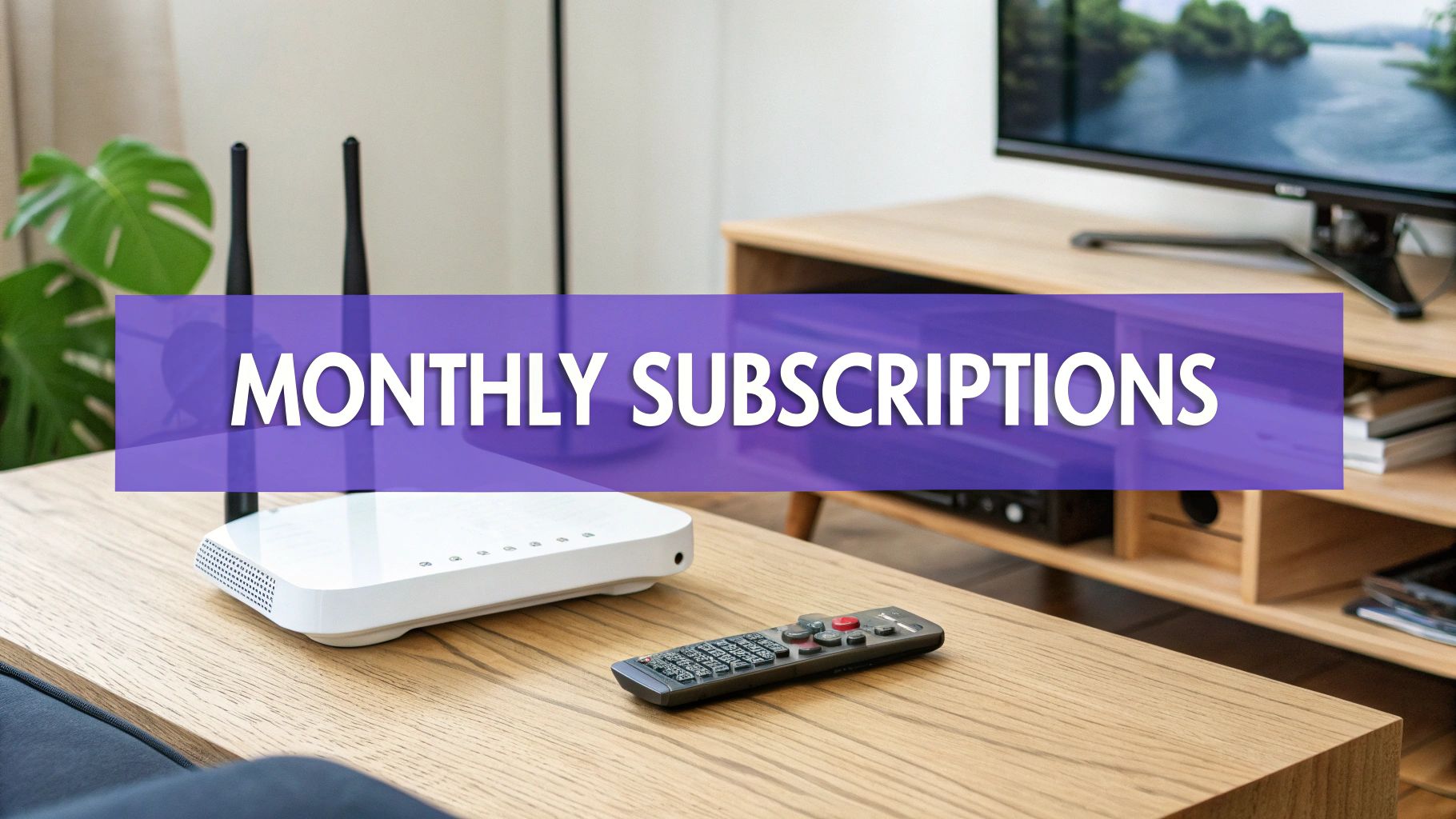
In today's connected world, digital services like internet, mobile phone plans, and streaming subscriptions have become essential utilities for most Canadians. These recurring monthly payments represent a clear example of fixed expenses, as they are typically billed at the same rate each month under a contract or subscription agreement. Whether it's a $90/month broadband plan from Rogers or an $85/month mobile plan from Bell, these costs are predictable and form a significant part of a modern household's budget.
The challenge with these services is their tendency to multiply. A single streaming subscription for $16.49 seems minor, but when combined with internet, a phone plan, and other services, the total can easily exceed $175 per month. While each individual charge is fixed, the cumulative total can grow unchecked without careful management, making it a critical category to monitor for effective financial planning.
Strategic Breakdown & Actionable Takeaways
Managing this bundle of digital expenses requires a proactive and organized approach. By strategically tracking and auditing these services with NeoSpend, you can prevent "subscription creep" and ensure you are not overpaying.
- Conduct a Quarterly Subscription Audit: Many people pay for services they no longer use. Use NeoSpend's subscription tracking feature to automatically identify all recurring charges. Set a calendar reminder every three months to review this list and cancel any services that are no longer providing value.
- Negotiate Annually with Providers: Internet and mobile providers in Canada are highly competitive. When your contract is nearing renewal, use your provider's own app or website to research competitor offers. Call your current provider, reference these deals, and ask them to match or beat them to retain you as a customer. This simple call can often lead to significant monthly savings.
- Bundle Services for Savings: Investigate bundling your internet, mobile, and even television services with a single provider like Bell or Telus. Providers often offer substantial discounts for bundled packages compared to paying for each service separately. Use NeoSpend to model the potential savings before making a switch to see the direct impact on your budget.
7. Childcare and Education Expenses
For Canadian families, few expenses are as significant or as consistent as those related to childcare and education. These costs represent a major, non-negotiable example of fixed expenses that fundamentally shape a household's financial landscape. Whether it's monthly daycare fees, which can range from a few hundred dollars in Quebec to over $1,500 in cities like Toronto, or private school tuition, these payments are predictable and recurring, making them essential to budget for with precision.
The predictable nature of these costs is their defining trait as a fixed expense. A family knows that the daycare fee will be the same amount each month for the year, and private school tuition is typically set annually. This consistency, while often daunting, allows for structured financial planning and is a critical component of a family’s budget. It’s a foundational expense that other spending must be planned around.
Strategic Breakdown & Actionable Takeaways
Managing these substantial costs requires more than just timely payments; it demands proactive financial strategy to minimize their impact and maximize available benefits.
- Track and Allocate Government Benefits: The Canada Child Benefit (CCB) is a key offset to these costs. In NeoSpend, create a specific category for CCB deposits. This prevents the funds from being absorbed into general spending and ensures you can track exactly how much of this government support is allocated directly against your childcare expenses.
- Model Future Scenarios: Before expanding your family, use NeoSpend’s forecasting tools to model the impact of childcare costs. Create a hypothetical budget that includes an average local daycare fee (e.g., $1,600/month in Vancouver) to see how it affects your cash flow and savings goals, allowing you to prepare years in advance.
- Maximize Tax-Related Savings: Private school tuition and certain other educational fees can yield valuable tax credits. Create a specific "Tax-Deductible Education" tag in NeoSpend for these payments. At tax time, you can easily filter and sum up these expenses to ensure you claim every eligible credit without digging through a year’s worth of statements.
Key Takeaway: Predictability is Your Superpower
Understanding your fixed expenses is the first step to taking control of your financial life. These predictable costs form the foundation of your budget. By identifying, tracking, and regularly reviewing them, you can build a solid financial plan, find opportunities to save, and reduce financial stress. Using a smart tool like NeoSpend can automate this process, giving you the clarity you need to manage your money with confidence.
Ready to see how NeoSpend can help you master your fixed expenses and reach your financial goals? Explore more of our financial wellness guides or Download NeoSpend today to get started.