Choosing between a Tax-Free Savings Account (TFSA) and a Registered Retirement Savings Plan (RRSP) comes down to when you pay taxes. A TFSA uses after-tax dollars to let your investments grow and be withdrawn tax-free—forever. An RRSP, on the other hand, gives you a tax deduction today, but every dollar you pull out counts as taxable income.
Understanding this trade-off will help you match your savings vehicle to your goal—whether it’s an emergency fund, a down payment on a home, or a comfortable retirement.
Quick Answer and Key Differences: TFSA vs RRSP
Here’s a quick overview to help you weigh tax-free withdrawals against up-front deductions based on what matters most right now.
- Tax Timing
TFSA contributions come from after-tax income; RRSP deposits reduce your taxable income immediately. - Growth & Withdrawals
With a TFSA, both gains and withdrawals are tax-free. RRSP withdrawals are taxed as income. - Contribution Room
TFSA room rolls over if unused; RRSP room is 18% of last year’s earnings (up to $31,560 in 2023). - Impact on Benefits
TFSA withdrawals don’t affect income-tested benefits. RRSP withdrawals can trigger clawbacks.
Side-by-Side: TFSA vs RRSP
| Feature | TFSA | RRSP |
|---|---|---|
| Taxes on Contribution | After-tax | Pre-tax (deductible) |
| Growth Taxation | Tax-free | Tax-deferred |
| Withdrawal Tax | None | Taxed as income |
| Annual Limit | $7,000 (2023) | 18% of income (max $31,560 in 2023) |
| Benefit Impact | No claw-backs | Possible benefit reduction |
| Best Use Case | Short-term goals, emergency fund | Retirement, high-income deduction |
This snapshot should help you see which account lines up with your goals.
Everyday Canadian Scenarios
- Emergency Fund
Need $500 for a broken water heater? A TFSA lets you withdraw without owing any tax. - First Home Down Payment
Use the RRSP Home Buyers’ Plan to borrow up to $35,000 tax-free, then repay over 15 years. - Retirement Top-Up
In your peak earning years, an RRSP contribution can cut your tax bill now and grow tax-deferred until retirement.
“Picking the right account today can save you thousands in taxes over a few decades.”
Quick Takeaway
- Compare your current tax rate with your expected retirement rate.
- Split contributions: TFSA for flexible access and RRSP for maximum deductions.
- Track your contribution room and growth projections with NeoSpend.
Review your TFSA vs RRSP mix each year to stay on track as your goals evolve.
Understanding the Difference Between TFSA and RRSP
When you compare a TFSA with an RRSP, the core idea is simple: both shelter your investments, but they follow different tax rules.
A TFSA is funded with after-tax dollars. Your gains compound tax-free, and you won’t owe a penny when you withdraw. An RRSP gives you a tax deduction today—your contributions reduce your taxable income. Later, withdrawals count as taxable income.
At a glance:
- TFSA: No deduction on contributions; withdrawals always tax-free
- RRSP: Tax relief up front; withdrawals taxed in retirement
- TFSA Room: Resets each year; unused room carries forward
- RRSP Room: 18% of prior year’s earned income, up to the annual limit
How Contribution Room Works
Each year, the CRA sets a new TFSA limit. If you don’t use it, that room simply rolls over—forever. RRSP contribution room is based on your previous year’s income, capped at 18% of earnings.
Imagine a recent grad juggling student loans and part-time work. They can skip TFSA contributions when cash is tight, then catch up later—without penalty. The unused room is waiting whenever they’re ready.
By contrast, someone nearing retirement in a higher tax bracket may top up their RRSP during peak years. Larger contributions mean bigger refunds now, accelerating retirement savings.
Below is a snapshot of CRA’s infographic illustrating TFSA mechanics.

This visual shows that withdrawals don’t reduce future TFSA room, keeping your strategy flexible over the long haul.
Comparing Tax Treatments
An RRSP deduction lowers your taxable income right away—ideal for high earners. When you withdraw, the deferred growth is taxed, typically at a lower rate in retirement.
TFSAs, by contrast, are perfect for lower-income savers or shorter-term goals. You pay no tax on withdrawals, so benefits like the Canada Child Benefit (CCB) or Old Age Security (OAS) remain unaffected.
“Timing matters. Choosing between TFSA and RRSP can save you thousands over a lifetime,” notes a seasoned financial planner.
With NeoSpend you can track both TFSA and RRSP contribution room, model growth scenarios, and adjust as your income changes.
Official CRA Resources
Dive into the CRA TFSA Guide for eligibility details, account history, and current limits.
Explore the CRA RRSP Page for deduction formulas, carry-forward rules, and the Home Buyers’ Plan.
With NeoSpend, you’re always synced with CRA data. It updates your available room, sends contribution reminders, and forecasts tax outcomes—so you stay within limits and optimise both accounts.
Tax Timing and Policy Implications
Deciding between a TFSA and an RRSP often comes down to when you pay tax and how policy shapes your goals. An RRSP’s deduction appeals to higher earners seeking a big tax break today. A TFSA’s tax-free withdrawals suit savers who want flexibility or need to protect benefits.
Short-term needs and future rate expectations drive most decisions. Savers in top brackets usually lean on RRSPs. Lower-bracket savers often favour TFSAs to avoid clawbacks on income-tested programs.
- Up-Front Deduction: RRSP contributions reduce your taxable income now.
- Tax-Free Growth: TFSA gains and withdrawals never show up on your tax bill.
- Income-Tested Benefits: TFSA withdrawals don’t count as income for GIS or CCB.
Income Groups and Preferences
| Income Group | Preferred Vehicle | Tax Impact |
|---|---|---|
| Lower Income | TFSA | No clawbacks, withdrawals untaxed |
| Middle Income | Mix | Balanced growth and relief |
| Higher Income | RRSP | Maximises up-front deduction |
These patterns reflect Canada’s policy design. Read the full research here.
Impact on Government Benefits
RRSP withdrawals count toward your net income and may reduce eligibility for GIS or OAS. TFSA withdrawals don’t affect income-tested programs—so your benefit levels stay intact.
- Keep an emergency fund in your TFSA to protect benefits like CCB or GIS.
- Plan RRSP withdrawals in low-income years to limit clawbacks.
Tip: Use NeoSpend to forecast how RRSP refunds affect net income and benefit eligibility.
By balancing TFSA flexibility with RRSP deductions, you’ll make every dollar work harder.
Contributions and Growth Patterns
Tracking how contribution limits shift over time can make or break your savings strategy. When the TFSA launched at $5,000 in 2009, few foresaw its widespread use. By 2020, the limit rose to $6,000, thanks to inflation adjustments.
Your RRSP room grows with your income—it’s 18% of last year’s earnings, up to the government’s cap. The good news? Any unused space in either account carries forward indefinitely.
- TFSA Annual Limits adjust each year for inflation.
- RRSP Room equals 18% of previous year’s income, capped annually.
- Unused Contribution Room rolls over forever—no deadlines.
Participation patterns have shifted. Early adopters favoured RRSPs for deductions. Today, many Canadians choose TFSAs for flexibility. Discover more about this growth.
Historical Contribution Trends
| Year | TFSA Share | RRSP Share |
|---|---|---|
| 2009 | 5% | 95% |
| 2012 | 18% | 82% |
| 2015 | 30% | 70% |
| 2018 | 45% | 55% |
| 2020 | 52% | 48% |
By 2020, TFSAs accounted for over half of registered contributions—a clear sign that many savers value penalty-free withdrawals.
Family Allocation Example
Imagine a household putting $500 a month into registered plans—$300 to an RRSP and $200 to a TFSA. That blend typically generates a $90 tax refund while building tax-free savings for emergencies.
Allocating contributions this way lets you tap RRSP deduction power and TFSA flexibility together.
Over five years, this disciplined approach can yield a much larger combined balance than favouring just one account.
Key Takeaway
- Calculate your unused TFSA and RRSP room.
- Set monthly deposits aligned with upcoming limit changes.
- Adjust allocations based on your marginal and future tax projections.
Use NeoSpend to monitor limits, chart growth and get alerts before you hit annual ceilings.
Withdrawal Rules and Benefit Impacts
When you withdraw from your TFSA or RRSP, the timing and rules you follow affect both your tax bill and your benefits. A smart withdrawal plan can protect your money and entitlements.
- TFSA Withdrawals: Tax-free, no withholding
- RRSP Withdrawals: 10–30% withholding, added to taxable income
TFSA vs RRSP Withdrawal Rules
| Feature | TFSA | RRSP |
|---|---|---|
| Tax Implications | Tax-free, no withholding | 10–30% withholding; taxed at your rate |
| Recontribution | Unlimited from Jan 1 next year | Permanent loss of deduction room |
| Special Relief Programs | N/A | Home Buyers’ Plan (15-year repayment) |
Since TFSA withdrawals aren’t counted as income, they won’t trigger clawbacks on benefits like the Canada Child Benefit or OAS. RRSP withdrawals, however, boost your income and may reduce eligibility for GIS or other programs.
Real-World Withdrawal Examples
- Sarah, 28, withdrew $2,500 from her TFSA for car repairs. Her Canada Child Benefit stayed the same. She recontributed the amount next year—no tax hit.
- Mark, earning $90,000, took out $10,000 from his RRSP for a kitchen renovation. He faced an 18% withholding and a projected OAS reduction of $150 per month.
- A retired couple accessed $5,000 from their TFSA for winter heating and kept their GIS benefits intact.
For full contributor counts and medians, see the latest data from Statistics Canada.
Key Takeaway: Use your TFSA for urgent needs and plan RRSP withdrawals in lower-income years to protect your benefits.
Choosing TFSA or RRSP for Your Situation
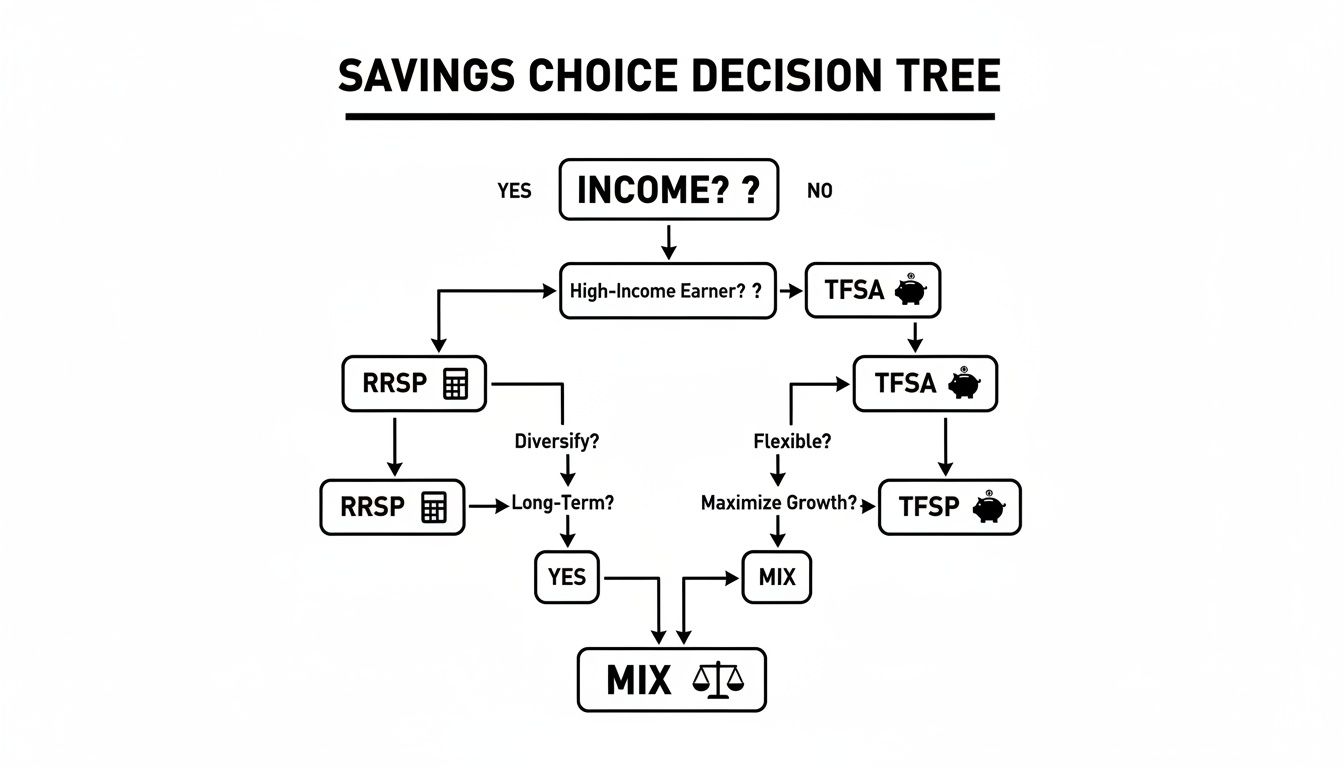
Different savers have different goals—students juggling tuition, families saving for education, freelancers with variable income. This section walks through five profiles and shows when to use a TFSA’s flexibility or an RRSP’s tax break. We’ll also highlight how NeoSpend helps you map limits and growth targets.
Students Launching Careers
Your income is likely in the lowest tax bracket. A TFSA lets you save with after-tax dollars and access funds penalty-free.
- Tax-free growth for emergency needs.
- Build momentum with small monthly deposits.
- Set NeoSpend alerts to track TFSA room and deadlines.
Young Professionals Saving for Homeownership
First-time buyers benefit from both accounts—and the Home Buyers’ Plan.
- Contribute to RRSP to lower taxable income now.
- Reinvest your refund into a TFSA or First Home Savings Account.
- Repay your Home Buyers’ Plan over 15 years.
“Using your RRSP refund to fund a TFSA can shorten your down-payment timeline,” says an advisor.
Freelancers With Variable Income
Irregular pay calls for a flexible plan.
- In high-earning months, contribute up to 18% of income to an RRSP.
- In slower months, shift to a TFSA for continued saving.
- Use NeoSpend’s forecast tool to preview your refunds, clawbacks and balances.
Families Funding Education
Tuition costs, daily bills and future goals require balance.
- Direct RRSP refunds into an RESP for government grants.
- Keep a $1,000 TFSA cushion for emergencies.
- Monitor all accounts in NeoSpend to avoid overcontributions.
| Profile Aspect | TFSA Use | RRSP Use |
|---|---|---|
| Emergency Buffer | Tax-free access for urgent bills | N/A |
| Education Savings | Short-term tuition top-ups | RRSP refund funds RESP contributions |
| Benefit Protection | No impact on Canada Child Benefit | Plan withdrawals in low-income years |
New Investors Building Wealth
When your horizon spans decades, tax brackets may change.
- Lean on a TFSA early to avoid higher future tax rates.
- Seasoned earners prioritise RRSP to reduce today’s taxable income.
- Sync both rooms in NeoSpend for a unified plan.
- Review your asset mix across accounts to match your risk.
Real-World Checklist
- Calculate unused TFSA and RRSP room with NeoSpend.
- Automate transfers aligned to your cash flow.
- Model withdrawal impacts on benefits using NeoSpend scenarios.
- Schedule RRSP withdrawals in low-income years.
- Recontribute TFSA funds starting January 1.
- Revisit your account mix annually.
Key Takeaway: Tailor your TFSA vs RRSP strategy to your tax bracket, goals and need for cash flexibility. A blend often gives the best outcome.
Frequently Asked Questions
Which should I fill first—TFSA or RRSP?
Fill your TFSA if you need an emergency fund or want to protect government benefits. Then shift to RRSP for immediate tax deductions once your safety net is set.
What happens if I overcontribute?
For TFSAs, the CRA charges 1% per month on the excess. RRSPs give a $2,000 penalty-free buffer; after that, a 1% monthly fee applies.
Can I transfer directly from RRSP to TFSA?
No. Withdrawing from an RRSP triggers withholding tax. You must use your TFSA contribution room to recontribute, which counts as a new deposit.
Managing Rooms with NeoSpend
NeoSpend syncs with CRA data to show your up-to-date TFSA and RRSP room in one dashboard. Its tools help you:
| Feature | Benefit |
|---|---|
| Real-Time Room Tracker | Avoid over-contributions with instant alerts |
| Growth Simulator | Project tax savings and balance growth over time |
NeoSpend also sends:
- Alerts before annual limit changes
- Monthly reminders to keep you on track
- Comparative scenarios for TFSA versus RRSP outcomes
No more guesswork—manage both accounts confidently.
Key Takeaway: Balancing TFSA tax-free growth and RRSP tax deductions helps you build wealth and protect benefits. Use NeoSpend to track your limits, simulate scenarios, and adjust as your life changes.
Ready to take control of your registered accounts? Try NeoSpend for free today or explore more guides on smart saving strategies.